The only contact that I had with poverty did not go into my mind as such.
Since I was a baby, my parents took me everywhere with them. They traveled by train and by bus. They owned a car much before I was born, but they had a bad accident and my father, being the passionate man that he was, swore that he would never put my mother at risk anymore, so, no car.
In many of these trips, and especially when leaving the capital and heading to rural areas, I saw people living in square boxes made out of wood, metal sheets, cartons and covered by pizarreño (asbestos planks), tree branches and other materials. I might have asked my parents why those people lived like that or not, but I guess that went into my child’s mind as another of those things that you accept as “that’s the way it is”.
At the farm where my grandparents lived, I used to play with Serguín, a boy of my age. He just would come in the mornings when I was visiting the farm and we would play with dry corn cobs, twigs, mud and other natural elements and reconstruct little villages, carriages, rodeo arenas and such. When lunch time came, my mother or father would come for me and tell Serguín to go to his home for lunch. Serguín was the son of one of the inquilinos of my grandfather. ( Inquilinos were people who lived on the farm in their own houses and cultivated their own vegetables and had some animals in exchange for working on the farm for a certain number of hours.) If Serguín had been the son of one of our neighbor farmers, he would have been invited to lunch with us. Also, another situation that was “just the way it is”.
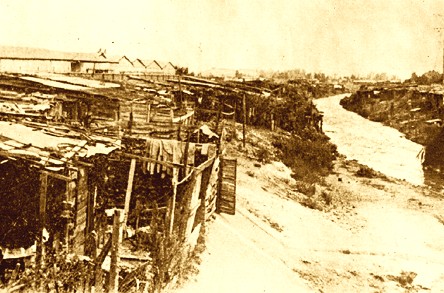
I think it was in one of our Informative Journalism class excursions that we were taken in a bus to the outskirts of Santiago to visit a shanty town or poblacion callampa (mushroom community).
Our professor, or his assistant, explained how people, who were “exploited” in rural areas by owners of farms, had escaped the inquilino system and come to the city in search of freedom and riches, only to find that in the city it was not easy to find a job and live anywhere without paying rent. They were “forced” to go to the outskirts of the city to live on land that did not belong to them and had been illegally appropriated by people like them.
The poblaciones callampas of Santiago de Chile, were “dwellings” built mainly with cardboard covered by tar or asbestos planks. They began to be seen in the 1940s, but their growth sharply increased between the 1960s and 1980s. These shanty towns multiplied overnight without any previous notice, like mushrooms.
Due to the amazing invasion of people, coming mainly from the south of Chile looking for work in the capital, the people already settled there created cheap housing for them. Conventillos and cités multiplied as people without any skills, kept coming to the city.
The conventillos or tenements were multi family lodging made by dividing single-family houses. Each room of the house became an “apartment” rented to a complete family. Usually they were in very poor condition. Each family room opened onto a corridor, or a common patio, where water ran in the middle and served as water provision and common toilet. The conventillo was obviously designed to only enrich the owner.
The cité were a group of houses, one next to each other, facing a public highway. The cités were built for better socio-economic groups like those with trades, especially in Santiago.
“The tenements, cités, and houses rented by separate rooms were unable to house the entire migrant mass that industrial development attracted. In 35 years, the state sponsored construction could not meet demand. The only possibility for the migrants was self-construction using waste materials and on property that did not belong to them. This, together with the increase of urban transport, especially towards the periphery, allowed the possibility of the first human settlements that the people baptized with the name of callampas (mushrooms).” (De Ramón, 1990).
The settlers, made up of migrants, began to settle on rough and abandoned land in various sectors of Santiago. Someone arrived and settled in a place where nobody had an interest. Then another relative or acquaintance arrived and settled next to it, and so a settlement is formed. The poblaciones callampas never was a real solution. Its occupants remained in these places temporarily, till they found a better housing solution, or so they said.
The occupation of the land was not legal. The callampa towns were settlements that were tolerated because they “did not harm anyone”, especially, according to politicians.
“In 1952, some 75,000 people lived in callampas, which meant 6.25% of the total population of Santiago; fourteen years later this number had risen to 201,217 people, or 8.05% of the total population of the city .” (De Ramón, 1990).
(Reference: De Ramón, Armando. 1990. “La población informal. Poblamiento de la periferia en Santiago de Chile. 1920-1970.” Revista EURE 16 (50): 5-17.)
These living conditions were a total eye-opening for me. I gladly accepted the words “social injustice”, “capitalism” and many others pushed by our teachers and many of my classmates that already were militants in the socialist or communist parties.
From then on, meals at my home were full of arguments between my father and me about what I was learning and what my father believed.
At that time I did not ask myself why these migrants did not remember what they used to have while still on the farms. When they went to the city, they didn’t realized that they could not cultivate their own vegetables and keep some animals to eat like they had done at the farms.
They wanted to be owners, they wanted to make money without having the city skills they needed to survive. They ended either living like paupers or leading a life of crime. They went from having a little, to having nothing.
It was very sad to go visit these shanty towns and see malnutrition, trash all over, kids drinking from the dirty drainage canal. These people who had been humble and hospitable when they lived in the countryside now were only in “survival mode”, but pretended to be better off. You could see a “house” made out of mud, pieces of wood and metal with a big TV antenna on the roof. However, if you peeked inside, there was no TV and no electricity, of course.
 An Ear by Mistake
You must be logged in to post a comment.