When Louis Armstrong came to Santiago Chile, he wanted to walk in downtown. It was summer 1957. In fact, he adventured out of the hotel with other members of his “All Stars” band. I was still a high school student and I had gone to downtown with my mother. We were near the main square when we noticed a commotion and people hurrying up to see what was going on. My mother was always cautious about these situations but, I was going to be a journalist, so we hurried up to another street to take a short cut and there, right in front of us, was Satchmo and two other members of the band. He looked at me and asked “What are they saying!” indicating the many children who were following them. My English was quite primitive at that time but, hearing what the kids were saying, I explained, “They want to touch your hair”. (Blacks were still a real oddity in Chile at that time). Louis Armstrong started laughing and bent down for a little girl to touch his head. The girl also laughed and declared in good Chilean “Se siente como un sommier”, and then all the children laughed. A sommier in Chile is a box spring made out of fine, curly wire.
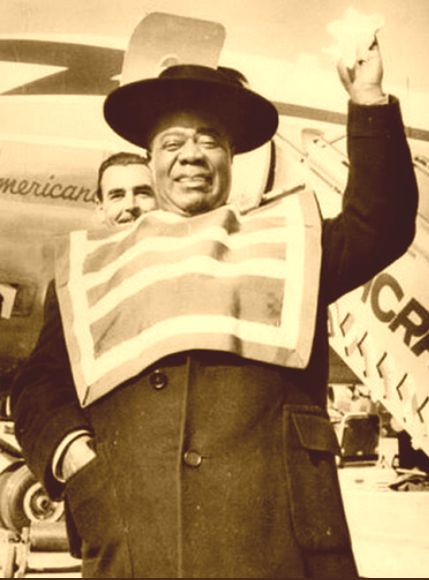
Louis Armstrong visited Chile again in 1962. His trip was sponsored by the 1962 World Soccer Cup Championship that was in Chile this time. He came off the plane with a poncho and hat, a typical outfit of the Chilean cowboy or huaso.
I was one of the journalism students selected to cover the World Cup. I was assigned to the port of Valparaiso where some of the soccer games were going to take place. The organizing committee trained all of the journalists who were going to cover the games to use special code terms to be able to rapidly report what was going on in the game. I enjoyed learning the “jargon”.
It was a cold month of June but people went in thousands to hear Louis Armstrong at the Velódromo Municipal (race track) in front of the Stadium in Valparaiso. Since I was there and I love jazz, I decided to go to see the Amstrong concert. With my press pass I was able to get near the scenario. I arrived early. I was looking for something to eat when Louis Amstrong stepped right in front of me. We looked at each other and I said: “May I touch your hair?”. He started laughing and said “Of course, I remember”. Then he and the Chileans that were with him continued walking. But some of the guys with him turned back to look at me with very puzzled faces.
My career in the world of sports lasted only for the time of the World Soccer Cup. I took it as an interesting practice, but it was not my cup of tea. However, it was fun to meet soccer personalities, such as Pele and Amarildo from the Brasilian team that won the Cup, Ladislav Novák from the then Czechoslovakia soccer team, that got the second place in the Cup. I also met Antonio Jasso and Antonio Carbajal from Mexico and Igor Netto and Valentin Ivanov from the Soviet Union team. The atmosphere of the tournament was quite violent, starting with the first match of the event between Chile and Italy. It was called the “battle of Santiago”.
Another interesting encounter I had in Chile was with Jayne Mansfield during her South America Tour in 1966. I was working as a journalist and I decided to go to the Hotel Carrera where every important person who arrived in Santiago would stay in those years. I had asked for an interview with the actress but did not get any answer. So I went to the hotel anyway and, as I walked through the entrance of the hotel which had a souvenir store, I saw this very blond, plain-looking girl with a scarf on her hair and a pinkish coat, looking at some items in the store’s showcase. I was puzzled because the girl I was looking at was without makeup, had freckles and acted rather timidly. She looked at me and smiled. She said “It’s a pity the store is not open”. It was around 2:00 pm on a Sunday. I said “It might open later”. She gave me a sad look and touching her face said “I must go and get ready and then go”. I was so surprised to see such a different Jayne from the pictures and movies that something told me not to ask her for the interview. She obviously was very tired and to me, at that moment, she was not the smart achiever depicted by Hollywood. Next year I learned about her tragic car accident in Louisiana.
Another rewarding experience was to meet the French singer Juliette Greco when she visited Chile for the first time. I went with my mother to hear her sing. I was enchanted with the profound voice and poetic hands. After the presentation she accepted to meet us and I expressed my admiration for her performance and especially for the way she moved her hands. It was nice to hear her say: “A bientôt petite fille tu auras du bien dans ta vie.” (See you soon little girl, you will have good in your life.) Later, I learned that in 1981 Juliette returned to Chile and performed at a gala, televised live, for dictator Augusto Pinochet and military officers and their wives. She gave a concert of songs that had been banned by the junta. She was taken directly to the airport after that concert, and expelled from the country. Later, in an interview she gave in London, she said about that concert in Chile, “I came on stage to a tumultuous reception, I went off to dead silence. That silence was one of the greatest triumphs of my career.”
Another artist that stole the heart of Chileans was Charles Aznavour. He was in Chile to film a movie in the north of Chile in 1962. He was very personable and enjoyed walking in the streets of Santiago, interchanging with the pedestrians. There is a famous picture of him having his shoes polished buy a shoeshine guy in front of the President’s Palace in Chile, La Moneda.
He was in the middle of filming “Le rat d’Amérique“, when I met him briefly at the airport. He asked me for directions on how to get a famous Chilean sandwich he had been told about. Some years later, in an interview, Aznavour said, “I lived the same life as the Chileans, I ate the same as them”. I can testify to that.
While the Congress of the International Federation of Democratic Women in September 1959 took place in Chile, I happened to meet Raul Castro, the brother of Fidel Castro from Cuba. I was in my first year at the Journalism School and I was covering the sessions to write an assignment. The conference took place at the Hotel Carrera. I waited for the elevator and, when the door opened, there were Raul Castro and Vilma Espin, his brand new wife, both dressed in the green uniform. She was the head of the Cuban delegation to the congress. They were very close to each other. They look at me and smiled and continued kissing and talking, showing they were very much in love. I did not know they were married but Raul said, “Si somos nuevos novios“. (Yes, we are newly betrothed.) In fact, they had married in January that year.
Another incredible opportunity presented when I was preparing my final examination to receive my journalism degree in 1962 and I learned that Kenneth Kaunda was coming to a meeting in Chile. One of the three themes I had to prepare for the exam was on the Apartheid in South Africa, and who better than a known African leader from Zambia, formerly Northern Rhodesia, to ask about it. Kaunda was an outspoken supporter of the anti-apartheid movement and opposed white minority rule in Southern Rhodesia.
I was able to interview Dr. Kaunda and obtained wonderful materials for my exam. Yes, you guessed it–when I randomly selected one of the three themes for my exam, I drew ‘Apartheid’ and I did very well in my written examination.
Chile’s President Eduardo Frei and Zambia’s President Kenneth Kaunda have been friends since 1960, when they met at Oxford University for a symposium discussing the problems of underdeveloped countries and copper.
Kenneth Kaunda is a Zambian retired politician who became the country’s first president from 1964-1991.
Kaunda was among a small group of political activists who had left the National Council of Congress to form the Zambia African National Congress (ZANC). Kaunda was unanimously elected as the president, and it was at this meeting that the name of the country was born. British authorities quickly banned ZANC and Kaunda was arrested on March 12, 1959. He was released on January 9, 1960, and on January 31 was elected the president of a new political organization, the United National Independence Party (UNIP). Unlike ZANC, the UNIP pledged to lead a non-violent struggle for self-government. (Rise 2025)
On October 24 1962, Kenneth Kaunda, the leader of the UNIP, officially became the first President of the independent state of Zambia.
 An Ear by Mistake
You must be logged in to post a comment.