According to my mother, Doña Catalina de los Rios Lisperguer, was known as La Quintrala because her hair was red as the flowers of “quintral”, a kind of mistletoe that grows in Chiloe.
According to historians, la Quintrala was born around 1604. Her origin was Spanish and German. She inherited the lands of her rich landowner family that she ruled with extreme cruelty.
Her family owned properties in Santiago, including the land beside the church and convent of San Agustin. The family also owned an estate in the countryside near Santiago.
These properties were maintained and cultivated using an enormous number of slaves and servants. She was pretty, very wealthy and powerful.
My mother said that the woman had stories of indecent sex with slaves and perhaps priests. She always carried a whip in her hand and used it very frequently. La Quintrala formed a fame as a woman of sacrilegious nature.
She seemed to enjoy slashing slaves. According to records she was frequently fined by the authorities because of slaves under her care dying.
In fact, La Quintrala murdered her own father, Don Gonzalo de los Rios by feeding him a poisoned chicken. Tradition says that she tortured a lover to death in the cellar of her Santiago home. Also, she ordered the assassination of a priest and attempted to stab another priest who had visited her, trying to “redeem her soul”.
The number of la Quintrala’s victims were probably hundreds. Slave deaths were not accounted for by the colonial judiciary system so nobody could tell the real number of her victims.
Since La Quintrala had a huge fortune and connections (she was the sister-in-law of a respected judge), she escaped the trials on all 15 documented murder charges made against her.
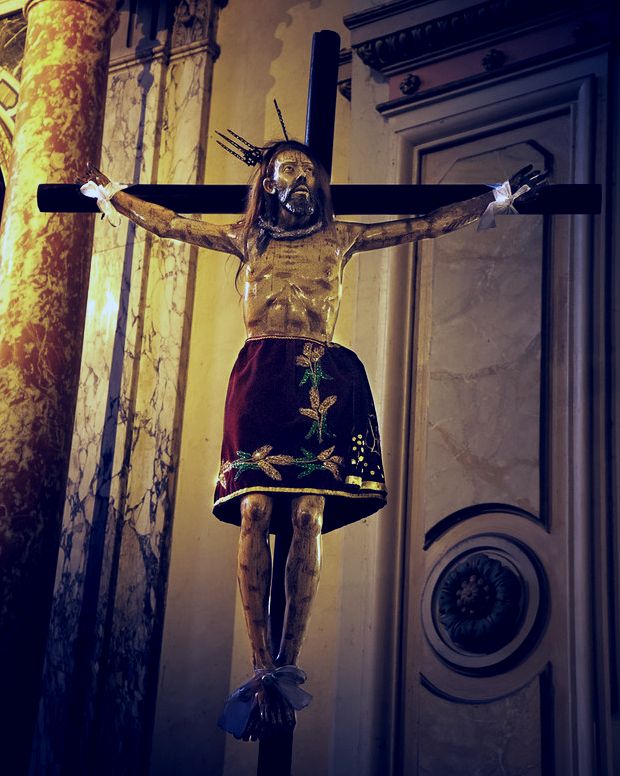
La Quintrala’s story is intimately related to the image of the Cristo de Mayo, (Christ of May or Lord of the Agony).
This sculpture was carved in 1613 by Friar Pedro De Figueroa, a friar who came from Peru. He felt that the churches in Peru had plenty of statues and paintings, and became concerned with the lack of images in the churches in Santiago. So he decided to sculpt many.
On May 13, 1647, there was a very destructive earthquake that devastated the entire Captaincy General of Chile. It destroyed entire cities. In Santiago, almost all houses collapsed except for part of the Church of San Francisco and some walls of the Church of San Agustín. The statue of the Lord of the Agony was kept in San Agustin (and still is).
The earthquake caused the crown of thorns on Christ’s head to detach and drop to his neck. The Augustinian Bishop Gaspar de Villarroel saw this, and he promptly tried to return the crown to Christ’s head. However, another quake came and it happened again. When the Bishop tried again to remove the crown, another strong tremor happened. So the Bishop gave up trying to return the crown.
The Bishop then ordered to organize a procession through the city and walk the miraculous image in procession to give hope to the people desolated by the earthquake. From that date onwards, for four centuries, a procession takes place on May 13 of each year, carrying the relic through the center of the city, to commemorate the events that made it famous. It is said that when the Christ has not been taken out in procession on May 13, earthquakes have occurred. This happened in 1959, 1984 and 2009, exactly one year before the biggest earthquakes in Chile.
To this day the crown is around Christ’s neck because every time somebody has tried to return it to his head, or remove it, another earthquake occurs.
La Quintrala was particularly fond of el Cristo de la Agonia (Christ of the Agony) and even kept it in her home after the earthquake of 1647. But her relationship with the crucifix was just as tempestuous as with the other men of her life. It is said that once she became furious because the crucified Jesus appeared to be staring accusingly at her provocative cleavage. Rumors said that she took her whip and punished the Christ on the cross, leaving the marks on the image. She ordered the immediate removal of the image, claiming that no men in her house had the right to give her “funny looks”.
When La Quintrala was dying in agony, she asked the Augustinian priests to bring the cross to her so she could repent of her sins and ask for forgiveness. When the priests brought the statue and tried to get it through the door, the statue turned and either one or the other post of the cross would hit the doorposts. There was no way to get the statue inside the house, and while they kept trying, La Quintrala died without repentance.
However, after her death in 1665, a large portion of her will was left for the conservation of the Cristo de Mayo and the procession of May 13. Her final request was for the Augustinians to hold 20,000 annual masses in her memory at the church beside her home. Her command is still observed today. (Moreno, Ramírez, Oliva,.et al. 2025)
 An Ear by Mistake
You must be logged in to post a comment.