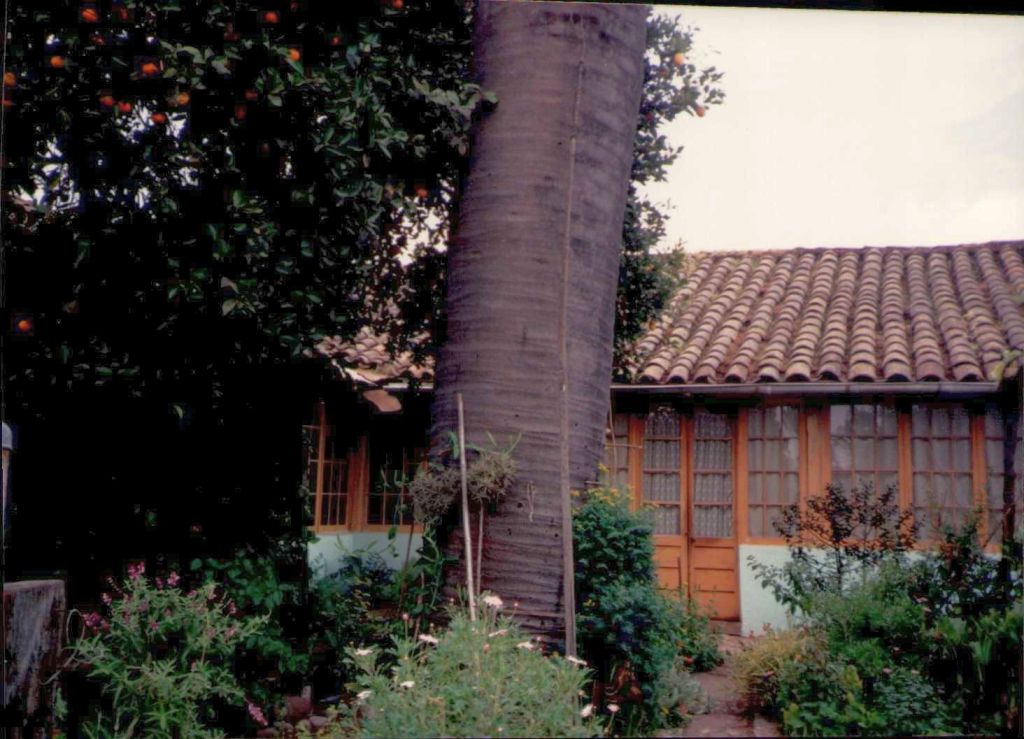
The house had three patios. The first one had an ancient palm tree in the very middle that produced little coconuts all year round. (The city hall records showed the tree was 300 years old in the 1940’s. Palm trees are protected by law in Chile and cannot be cut without special and expensive permissions.)
The palm tree was surrounded by small narrow trails, with no apparent designed, that allowed my aunts to water the extraordinary plants and flowers in the enormous garden.
The house was on a corner in the main street of the village. It was a typical colonial one-story adobe house. The main door and only entrance from the front was double and heavy. The side facing the main street was painted white. One of the windows was converted to a store display and a small door was added next to that display. One of my aunts had installed a “Crafts and School Supplies” (and small coconuts from the palm tree) shop, facing the street, in what used to be a bedroom with its corresponding half bathroom. She built a counter with glass top to display the items and covered the back wall with cabinets to store the merchandise. Another big bedroom had been remodeled and rented to a pharmacist. It was quite a big pharmacy with two doors and a window in the middle. There was no access to the pharmacy from the house.
When you opened the main door to the house and entered, you found yourself in a hallway with tiled floor, two patio benches, several tall planters with ferns, a small rubber tree, and further on, a door with glass.
The hall took you to the narrow enclosed walkway with tall windows and doors looking out to the patio. This walkway surrounded most of the entire first patio. My grandparents used to seat in that walkway and watch the pictures with “half naked men” on the TV that my father brought to grandmother. (The half naked men were the Indians in the cowboy movies.) Some times the mother of the Lebanese owner of a fabric store will come for tea at the walkway. She did not speak a word of Spanish but grandmother and she were great friends.
To the left of the garden was a big long arbor full of grapes. A gigantic table with at least 8 chairs and some beach chairs under the arbor provided a nice venue for summer lunches.
The garden plants were incredible. One of my aunts cultivated “copihues”, the national flower of Chile, which she sold or donated for weddings and special occasions. White copihues for weddings, red for anniversaries, white spotted with salmon for funerals.
Another aunt, my godmother, cultivated hydrangeas, lilies, callas and many more big strikingly beautiful flowers. The perfume of the first patio was a most pleasant first impression when visiting my grandparents.
The part of the house surrounding the second patio had been converted to an apartment that my aunts rented to a nice young couple. But they had kept the patio itself to lodge their strawberry garden and a chicken coop. They also raised rabbits.
The third patio had been separated from the house and sold to another person before my father bought the house.
When my grandfather’s arthritis became really bad and my grandmother and aunts were not able to keep the farm by themselves anymore, my father had found and bought this colonial house in the closest village.
The house was completely destroyed by the 2010 earthquake in Chile and coincidentally, exactly one week after my mother died at 100 years of age.

 An Ear by Mistake
You must be logged in to post a comment.