
When the cold and humid weather in the South of Chile was totally impossible to handle by my grandfather because of his arthritis, they had to move to a better climate.
The task for my father, who already lived in Santiago, the capital, was to find a farm in the central valley of Chile where the climate was milder and the potential of producing fruit and grain was better.
After much research and riding many buses and taxis, he found an interesting property that had several non contiguous fields. In one of the fields they could build a house, a barn, a winery, and some other facilities. So father bought the property, and the big move was done, by train and then trucks, from the farm called “Los Robles” (Oaks) in Constitucion to “Las Hijuelas de Puquillay” in the Colchagua Valley. The move included a faithful employee of my grandfather, el “Maucho”, a Mapuche who had known my grandfather since he was a child.
The valley of Colchagua is one of the nine more famous regions for the production of wines in Chile. So my grandfather was finally going to get the quality of red wines he had dreamed of. This farm had a completely different climate and soil than the farm in the South of Chile. By type of wine, he was moving from Chardonnay, Sauvignon Blanc, Pinot Noir, Cabernet Sauvignon and Syrah to Bordeaux, Carmenere, and Pais, but still able to keep the Chardonnay, Sauvignon Blanc and Syrah also.
My maternal grandfather Emilio, and my uncle Emilio, who was still very young, came to help with the building of the house. The house started quite humbly and some facilities were later added, like a big huge restroom. At the beginning, my grandparents had installed only an outhouse. I don’t remember a half moon on the door, but I do remember, when I was probably about 2 years old, being carried by my father holding me firmly in the lap of his “castilla poncho” to take me to the outhouse when it was raining at night.
The new inside restroom was a real novelty in that area. Grandmother Hortensia had to bring several helpers to prepare the house for the number of visitors they expected to come to see the “new room”. I believe it was then that I met my great aunt Celmira, the sister of my grandmother, when she came all the way from Concepcion (in the south of Chile) and travelled by train to visit her sister. That was another event, of course.
The restroom was enourmos. Big decorated tiles in white, grey and blue covered the floor of the whole room. It had a huge bath tub with lion’s feet, I thought. It had an incredibly big lavatory with ample counter and, a medicine cabinet with a mirror on the front. I remember that the toilet was very tall so I had to use a little stool to climb up there. Fortunately, the supply of magazines next to the toilet was really good. I learned a lot in that restroom.
Also in that restroom was a brand new Hoover wahing machine, but the clothes were hung outside to dry. The clothes, especially the linen, smelled so good after being dried by the sun.
The restroom had three doors. My grandparents had direct access from their bedroom. Another door opened into the front hall that gave access to the other bedrooms, and the third door gave access to the back patio of the house where the olive tree was.
My aunt Lily, the younger sister whose bedroom was right in the front of the house and had the best view of the garden, got her own 3-piece small bathroom. I wondered if she was pampered by my grandmother.
My grandfather Juan Manuel, started dedicating his attention to the vineyards, lemon and orange trees, and wheat and corn. His wine was well known and sold well to the big companies in Santiago. These companies bought wine in bulk from the wineries and then bottled, branded, and sold the wine.
Going to visit the farm house was a joy, especially in September, when my grandfather had a wonderful exhibit of fireworks, celebrating the Independence Day of Chile.
It was also nice during vacation time in the summer when all my cousins would also come, and we’d have fun playing different games on the big cement porch that was also added to the front of the whole house, except in front of the bedroom of my aunt Lily.
When only my parents and I were visiting, I played with Serguin near the creek. In the summer, my mother would bring her swimming suit and mine, and we would have fun in the creek and sometimes in the river nearby the farm house.
My father would open his improvised outside dental clinic and pull teeth and clean teeth for free to anybody that needed attention. But some people would bring a chicken or fruit in gratitude.
The most fun for me was to visit the corral with the horses, sheep and goats. The small kids would come and hit you in the seat if you bent over for a minute. I also had a favorite little pig that was all white and I called her “Princesa.”
When one of the pigs or lambs was going to be slaughtered, I would take my horse “Regalona” (Pampered) and ride far from the barn so I did not hear the animal squeal. My heart ached for a long time, especially when I had petted them when they were young.
With Regalona I could collect food from the trees. She would stand very still and I would stand on the English saddle and pick apples, pears, cherries. She loved the apples, so I had to collect those first.
My grandfather made sure to take me to the Bodega (winery) and teach me about the different wines. The wine was in “fudres” which were very big and were fixed to the ground in a vertical position and did not move. They had this interesting, well-adjusted little door on the side that was only opened, and very rarely, for cleaning the fudres.
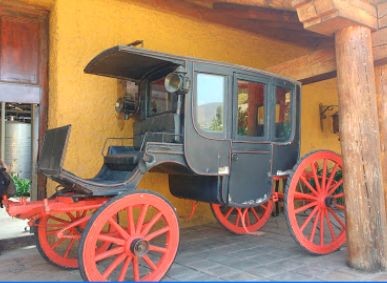
Of course, my grandparents did not drive at all so they used horse carriages. They had a two-seater, one-horse carriage and a four-seater, two-horse one. I liked the one-horse because it was faster.

 An Ear by Mistake
You must be logged in to post a comment.