One thing Filomena was absolutely sure about was that after spending time in purgatory she will go to heaven and then resurrect with the rest of the good Catholics.
So shortly after she had her daughter Clara, she started to prepare two big boxes. One with things for her daughter to have when she got married and her own resurrection box.
She had told the priest about her resurrection box, and the priest told his good friend the pharmacist.
Nobody was sure what Filomena had in her box, but the pharmacist, who employed her daughter, suspected that Filomena’s box had money, a gun, seeds of all kind of flowers and her wedding gown.
Filomena had told the pharmacist that in her daughter’s box she had put her wedding dress.
Sadly, the box that Filomena prepared for Clarita’s wedding was never used because Clarita left town with the good looking Floro. So the priest and the pharmacist decided that Filomena added Clarita’s box’s contents to her own resurrection box.
However, what Mr. Barceto in Santiago learned, when Filomena bought the second St Anthony, was that Filomena had also acquired an Indulgence from a lady who visited her village during the summertime, Mrs. Perez-Zavala.
This lady was a friend of a rich owner of a vineyard who employed Filomena when she gave big dinner parties. The owner of the vineyard invited Mrs. Perez-Zavala each summer, and she enjoyed the hospitality and participated and contributed with her aristocratic presence to all social events at the vineyard.
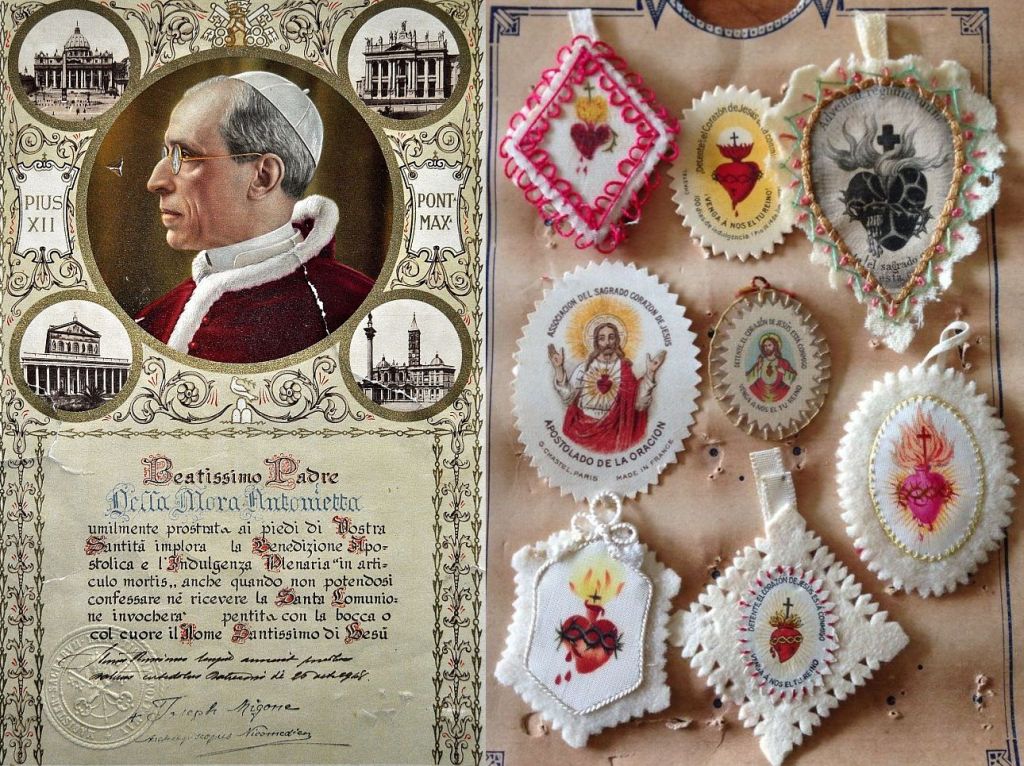
Mrs. Perez-Zavala was a widow and, while her husband was alive, they had gone to Rome to see the Pope. They had obtained four printed Indulgences that, among other advantages, insured the owner less time in purgatory. Filomena understood that in the Catholic faith, venial or minor sins, cause “temporal punishment” given by God to purify His children. A venial sin created a debt to God’s justice that must be paid (atoned) for. It was possible to pay for temporal punishment through good works, prayers, almsgiving, suffering, a pilgrimage to the Vatican or an indulgence. An indulgence is a remission of punishment (a kind of a certificate, usually with the image of the Pope). The indulgence can be partial, when it removes part of the temporal punishment due to sin, or plenary, when it removes all punishment.” Filomena hoped for a plenary indulgence which will warrantee that she did not spend time in Purgatory, but something is better than nothing.
It was questionable if these indulgences were transferable or not but people did not have any problems in negotiating them for good money.
Since Filomena was such a great listener one afternoon, while dinner was prepared, Mrs. Perez-Zavala had confided that since her husband died she was having real financial problems. She was really grateful to the owner of the vineyard that invited her each summer to live for free, but she was so needy the rest of the year that she was wondering if somebody was interested in one of her indulgences.
Filomena could not believe how wonderful St. Anthony was in bringing her this opportunity.
Of course, Filomena could not afford the price Mrs. Perez-Zavala asked for, but she promised, that if she would accept a deposit then, the next next summer she would give her at least 10% more of the original price.
As far as Filomena knew, her resurrection box was now complete. The money she had collected there served for the down payment for the Indulgence.
She had the gun of her former husband Rigoberto, “because the devil always managed to slip some bad elements everywhere”. So together with the gun, she had some detentes in small frames, and escapularios to wear in her neck.
A detente is a holy card made with fabric and used for reflection in prayer. Before the printing press, Catholics made handheld holy cards on pieces of paper or embroidered on fabric. Usually, they depicted the Sacred Heart of Jesus, or the Immaculate Heart of the Virgin Mary. They were surrounded with an ornate frame or beading. The escapulario (scapular) originally was a part of the monastic habit (the outfit worn by monks). It’s mostly like an apron used for BBQ. It is composed of two large pieces of cloth, connected in the middle by narrower strips of cloth, much like an apron that covers both the front and the back of the wearer. The opening between the strips allows the monk to wear the scapular around his neck so the strips sit on his shoulders, and the large pieces of cloth hang down in front and back. The scapular gets its name from the Latin word “scapulae”, which means “shoulders.” However, the term “scapular” now refers to a small religious object that has essentially the same form as the monastic scapular but on a very small scale. It is usually done in wool cloth of an inch or two square, and thinner connecting strips made out of ribbons. They are worn by faithful lay Catholics, as well as those in religious orders. Each tiny scapular represents a particular devotion and often has a certain indulgence or even a revealed “privilege” or special power attached to it.
Filomena also had seeds of flowers because somebody had to keep heaven beautiful.
She had pictures of her parents, her wedding, and her daughter at different ages, a rosary and a set of silver spoons.
The box also had her wedding dress and her wedding nightgown. She always thought that she could have married another man, but she was already 18 when her neighbor Rigoberto asked her parents for Filomena’s hand. Her mother convinced her that it was better to have a bird in her hand than 100 flying around. Rigoberto was already an older man at 42. He had never married because he took care of his mother and the property after his father died when he was only 13 years old. So Filomena’s married knowing that she would probably become a widow soon. Sure enough, Rigoberto died at 55 from a heart attack. Filomena kept her wedding gown hopping that she would find another man. But after years went by, she decided that she would have a new husband after resurrection.
 An Ear by Mistake
You must be logged in to post a comment.