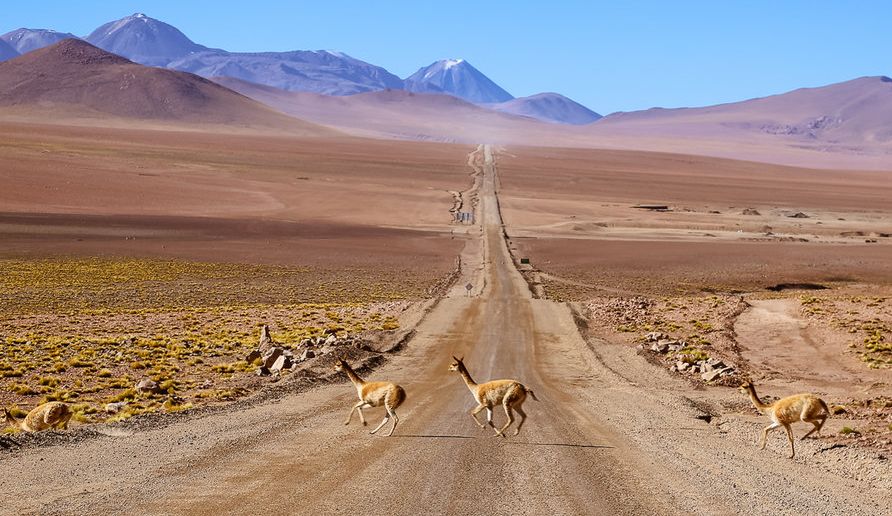
At that time I was teaching at a University in the North of Chile. If I wanted to see a good movie that had just come up, I had to drive 19 hours without sleeping to go to the capital, Santiago. (It would take months for that movie to arrive at the theaters of Antofagasta.)
So a friend and I would pack my Citroen Deux-Chevaux and depart around 7:00 by night, headed toward the South.
Antofagasta is in the Atacama desert which is a plateau covering a 990-mile strip of land on the Pacific coast, west of the Andes Mountains. The Atacama Desert is the driest desert in the world, meaning that is the only true desert to receive less precipitation than any other desert in the world. It is also the largest “fog desert” in the world. The fog is a mist known as the “Camanchaca” that rolls in from the Pacific. A blanket of fog sweeps across and down the desert hills attracting tourists and photographers to the desert.
Fog condensation supplies the majority of moisture needed by animal and plant life in the desert and, in special occasions, when all the weather conditions have been right, it covers the desert in the most incredible display of flowers. Also, thanks to Israeli agriculture specialist and the fog, some parts of the Atacama dessert have been converted in fertile areas where the fog condenses on strategically placed nets with microscopic droplets. Wonderful grapes and wine are product of this miracle.
The Atacama Desert occupies between 41,000 square miles or 49,000 square miles, if you include the barren lower slopes of the Andes when measuring. Most of the desert is composed of stony terrain, salt lakes (salares), sand, and felsic (quartz) lava that flows towards the Andes.
The distance between Antofagasta and Santiago de Chile by car is 1.378 kilometers or 860 miles. Temperature differences between day and night in this desert can vary up to 45 degrees and, while in the middle of the day, temperatures can reach up to 80 degrees Fahrenheit, that same night you can easily experience from 35 to 40 degrees Fahrenheit.
We would travel with boots on, knowing that as soon as the cold night in the desert would strike, we would have to take them off so we could remain awake, thanks to the cold feet. We couldn’t run the risk of falling asleep while driving because the car could easily get off the road. The lights of a car in that desert are not enough to find the road again in the dark. Also, the compass goes crazy in that desert because of the magnetic forces of the mineral rocks, so we could get lost with no return.
In fact, two of my students had gone to the desert for a weekend, and it took four days to find them using a helicopter, which also experienced difficulties when trying to land and take off.
At that time, there was only one stop in the desert to have a bite to eat and refuel the car, Restaurante Aguas Verdes. And it still there.
Between Antofagasta and that stop, always full of truck drivers, there is just a moonless night in the middle of the desert.
This time my friend and I were prepared for the cold night with a bottle of pisco, salami and a French baguette.
I was carefully driving, while listening to our music selection in a cassette, when suddenly we were in plain daylight, or so we thought, because we could see everything around us as if the sun were up. We saw some vicuñas running in front of the car, surprised by the strong light. The car stopped running.
The light was just on top of the car and allowed us to see about 20 feet around it. I tried to start the car again but it wouldn’t start.
I jumped out of the car bare footed and looked up. I was blinded by the light directly on top of the Citroen and my feet were standing on a very warm road. There was a strange, low sound surrounding the car. A combination between the purring of a cat and zooming.
I got back inside the car and told my friend “We are probably going to be abducted and taken to another planet”. So we laughed and waited surrounded by the almost comforting strange sound.
After 4 to 5 minutes, we saw the light illuminating a much larger area around the car and then it was dark again and the car started by itself.
The visit had ended and we had not been abducted.
As soon as we arrived at Aguas Verdes, a truck driver asked: “Did you get stopped by the bright light?” Yes, they had all experienced something similar and were talking about calling a radio station or a newspaper to tell the press what had happened.
I promptly intervened and told them that I was a journalist and a professor teaching journalism at a University. I told them that the press would make a big deal of this and cause immediate panic. Would they want that to happen?
So the discussion cooled down, and the truck driver, who was going to call, said that he, after all, didn’t want to spend his money on an expensive phone call. The bartender and the waitress said that these happenings were quite common in the desert, and the excitement little by little died.
At that point, I decided to tell the friend I was driving with and the three truck drivers at our table the story the Director of the Observatory of The University of Chile in the Atacama desert had told me when I was working at the Public Relations office of the University.
A professor at the University had assigned two astronomy students to stay at the observatory for a certain time to perform some measurements and have a real life experience of what they would possibly face in their professional world.
One night they saw what it seemed to be a meteorite coming down at an incredible speed near the observatory and, they heard and felt an enormous crash.
They decided that they needed to investigate, and one of them left the observatory in the pickup truck they were using. After one hour, the second student started to worry and decided to pick up a big lantern and walk toward the place where they had thought the object went down.
When he started his walk, he noticed a subtle glow coming from the direction he was going. He had covered quite a distance when he finally saw the pickup truck parked right near a little hill. The truck was empty, and the glow was much stronger behind the hill. So he started goin up the hill.
Just before reaching the top of the hill, he heard the voice of his classmate. He pointed the lantern in the direction of the voice and before him was his friend with his head covered in totally white hair and a full-grown beard also white. He could hardly believe what he was seeing, and his friend, who looked much older, was not speaking in a known language.
Evidently, his friend did not see him or recognize him and kept speaking and walking down the hill.
Then he managed to grab one arm of his white-haired friend and take him to the truck. He drove him straight to a hospital in Santiago. During the long drive, the now old student kept speaking an unknown language and moving his arms as if he were talking to somebody.
After several medical examinations, the student was placed permanently in the Psychiatric Hospital in Santiago. The doctors estimated that he had a traumatic experience that caused him to age in few hours.
After finishing my story and our rest in Aguas Verdes, my friend and I continued our trip to Santiago. But we had not gone far when we ran into the dense fog that forms in the highest part of the desert plateau. We could not see beyond a meter (about a yard) before us. I asked my friend to drive and I went in front of the car with a flash light. It took us almost an hour to get through this part of the road. When the fog finally cleared, we realized we were in the highest part of a very narrow area where the cliff was on both sides of the road!
We thanked God for our lives and made it to Santiago just in time to see the movie.
 An Ear by Mistake
You must be logged in to post a comment.