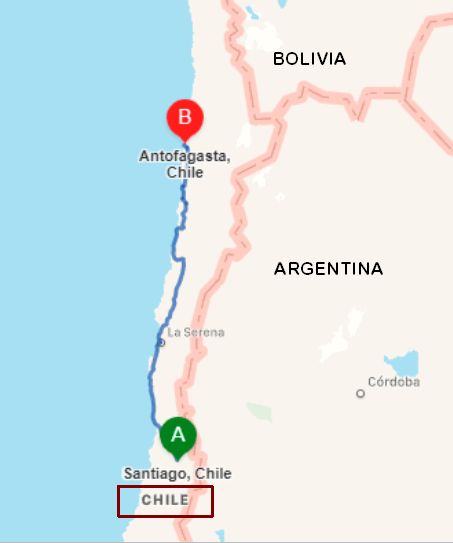
Driving back to Antofagasta from Santiago was really another adventure. After seeing our movie, or movies, visiting with my parents and relatives for a bit and buying some provisions that were much more expensive in Antofagasta, especially wine and Pisco (which is really a brandy made out of grapes and completely transparent, if it is of good quality) we departed for the North.
My friend and I would carefully plan the time to return so we could again travel through the Atacama desert by night.
We usually calculated to arrive early in the morning to Antofagasta and go to our houses, so we had time to shower, change clothes and arrive in time for work at 9:00 am.
Since our vehicle was a Citroen Deux Chaveaux Fourgonnette, we never knew what could happen on the road so we calculated a couple hours cushion for the trip. That meant 21 hours in total. So our best bet was to start our trip from Santiago around 11:00 am calculating the arrival to Antofagasta before 7:00 am.
On this particular trip we had bought salami, good German pumpernickel bread, canned tomato juice, a case of Pisco (12 botles), Viña San Pedro’s Cabernet Sauvignon wine and some other nice provisions that would last for some time.
We departed around 11:00 am from the house of my parents, where we had stayed for the night, after seeing our movies and having a very late “dinner”.
It was a typical June day in Santiago with a temperature around 48°F so we were well prepared again with winter clothes and good boots. I even carried a raincoat just in case we had some rain going north. This would be very unusual because if a drop of rain ever fell on Antofagasta, it was declared a national disaster!
As usual, the exit from Santiago took a long time because of the heavy traffic, but we were able to get to Coquimbo about four and a half hours later for an early “onces” (tea time) since we did not stop for lunch before. But it took us less than 30 minutes to have a cup of black coffee and a “churrasco” with avocado. (Churrasco is a sandwich made with a grilled thinly-cut steak and served on fresh baked French bread topped usually with tomato and avocado.)
Then we continued to Copiapo, but we did not stop at all knowing that we had plenty of fuel to make it to Aguas Verdes, the trucker’s favorite stop.
The original Citroen was supposed to get 80 miles per US gallon, but in reality, my little Citroen Furgonnette did not get that many miles, perhaps because of the weight of the van section that also had one small window on each side and two extra seats for passengers. The capacity of the fuel tank was less than six gallons and lasted about 200 miles. So I carried three plastic five-gallon containers of extra fuel to make it to Aguas Verdes at 998 miles from Santiago.
Fortunately, this Citroen was modern enough to have a fuel gauge. Prior models used a dipstick/measuring rod to check the amount of fuel. So it was easier to know when the fuel was about to run out, even though I suspected the gauge was not precise at all. When the little car started coughing, then it was a good time to stop and fill the tank again.
Next, the only thing to do was to wait a few minutes for a good-hearted, courteous truck driver, always ready to help me, to lift the container and fill the tank. It was also time to have a good chat about the conditions of the road, the weather, the kind of cargo the trucker was transporting, his family, his problems, etc. Very often the conversation had a funny way to inevitably evolve to the tree in the desert road that had a sign saying, “Estoy con sed! Tiene algunas gotitas de agua con que convidarme?” (I’m thirsty. Do you have some drops of water to invite me with?) The tree was green and healthy because you could not pass without giving it some water.
By that time in Chile, it was a real pleasure to drive to the North of Chile knowing that the truck drivers had a real code of honor and helped anybody driving in that immense solitude. Even a thirsty tree.
After Copiapo, it was only about two hours to Aguas Verdes where we needed to refuel the tank and containers to be able to make it to Antofagasta, more than five hours and 250 miles from Aguas Verdes.
We arrived at the gasoline stop about 11:00 pm. First, we loaded the car and gas container, and then we took almost an hour to have some food and more good conversation with the guy at the counter, the waitress and, of course, the truck drivers. Some remembered our adventure with “the visitor” on our trip to Santiago and we had a great time eating and chatting.
When we departed, we noticed that the car coughed a little, but my friend and I were so happy to be on our last leg of the trip that we just took our boots off and continued talking and enjoying the very cold night. The windows were quite covered by our respiration. We had to wipe them constantly.
The dawn took us almost by surprise, showing a thick camanchaca fog coming on top of the mountains like a gently placed tablecloth driven by the hands of angels.
Suddenly, when we were only about 50 miles from Antofagasta, the car coughed, trembled and stopped. “Not again”, we both thought, but we could not see any strange light or hear any strange sound. We both got out this time to check if a big UFO was on top of us, or any other phenomenon, but nothing. However, when I got into the car again, I noticed that the gas gauge was showing “empty”.
We were out of gas! We could not understand how that happened. We had calculated the amount of gas we needed and gottten the right provision, we thought. We thought about waiting for a truck to ask for a little bit of gas. We were prepared to pay for it. But we sat a long time and no truck.
Then the light came on my head! We had Pisco! Carefully I took a couple of bottles of Pisco and poured them into the tank. Expensive fuel, I thought, but worth a try.
Sure enough, after some tries, the ignition system took off and the car moved. Chugging along we arrived at Antofasta. I drove straight to the garage where my good mechanic friend next morning could check the car and see if the Pisco had done any damage.
I left a note on the car, and we were able to find a taxi to take us, provisions and bags, to our places.
In the middle of the afternoon, I got a call from the mechanic, “The car is working better than ever,” He said, “but don’t get any ideas that I’m putting more Pisco on it.”
 An Ear by Mistake
You must be logged in to post a comment.