One day unexpectedly Karelin came to my office and asked me if I like cruising. “Of course, I said, I have done a couple, and I thoroughly enjoyed them.” She said she had done cruise to Alaska recently and she wanted to do another with the same cruise line. “How about doing one together around South America?”
We booked on Holland America going from Rio de Janeiro, Brazil to Buenos Aires, Argentina to Montevideo Uruguay. Then to the Falkland Islands, Argentina, down across to Cape Horn to Ushuaia, Argentina, the Beagle Canal’s glaciers, Puerto Montt, Chile and ending in Valparaiso, Chile. At the end of the trip, we were going to stay in Chile for a while so I could visit with my family.
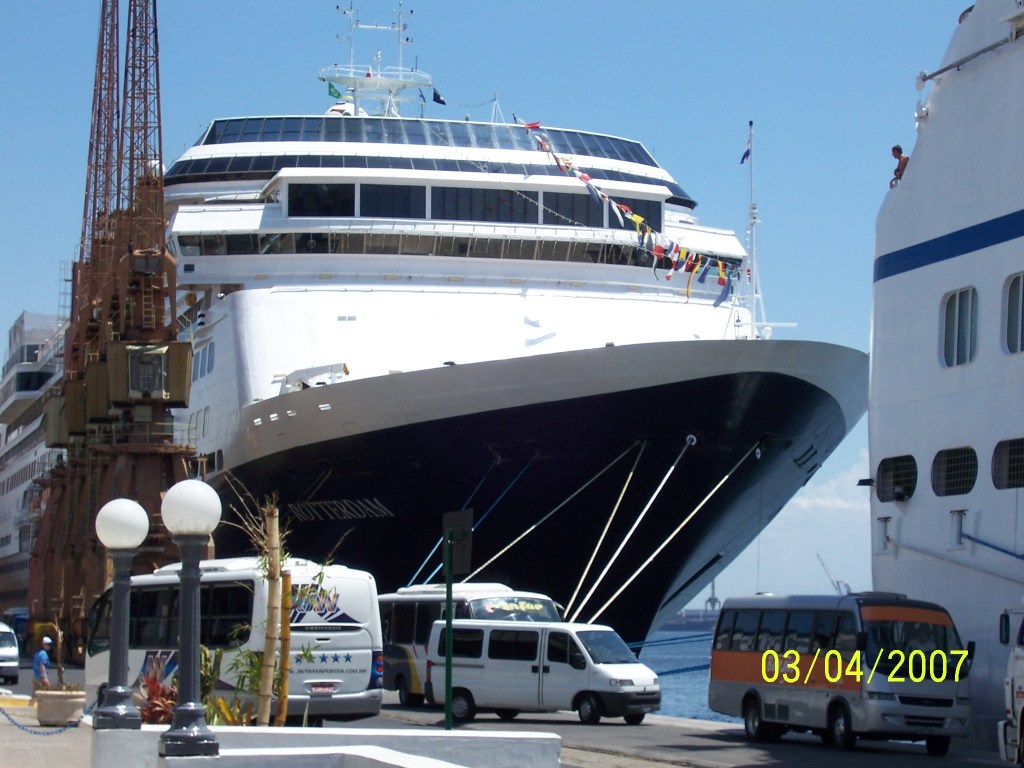
We departed Dallas on March 3, 2007. After spending a night at the house of a very dear friend in Miami, we left Miami Airport for Rio de Janeiro. There, we boarded a Holland America ship, the Rotterdam.
At that time, we were both still working in a missionary organization.
Since we were born only six months apart (on two different continents) we have reached retirement age. My friend Karelin had already decided to retire that year. I was still debating. Karelin suggested the trip since she had never been in any of the countries of South America except for Colombia. Since I was born in Chile, she knew that I would not have any problems with the language.
Our flight was fine. We arrived in Rio around midday, but we were supposed to board around 4:00 in the afternoon. Holland America sent our transport to the airport, and, to our surprise, it turned out to be a good tour of Rio de Janeiro before boarding. From the International Airport to the Cruise Port, we saw the Island where the Cidade Universitaria (Federal University) is, then we saw some Favelas (shanty towns) on the hills, we went up a little in the Corcovado Mountain, where Christ the Redeemer statue is, but we didn’t visit the statue. We continued to Ipanema Beach, then Copacabana Beach, then we saw at a distance, the famous Morro de Babilonia Favela, we passed through Botafogo, took pictures of the Catholic Santa Luzia Church, and then we arrived at the Port.
The ship was quite impressive. I took pictures of every deck we could get on. We had an interior cabin where great stewards from Indonesia that took care of us.
Then we dressed up for dinner and we met our dinner companions. An enchanting lady with her daughter. The daughter had left her two children at home to accompany her mother on this trip. And a nice couple our age. We stayed at that table during the whole 12 days of the trip.
March 5 and 6 we spent at sea visiting various places on the ship. We especially enjoyed the Crow’s Nest on the observation deck. We also discovered our dining companions were much fun to be with.
On May 7 we arrived at Buenos Aires, the capital of Argentina. Instead of taking a tour designed by Holland America we decided to take a taxi and go to the most popular Barrios (neighborhoods) in the city. I asked the driver, who was from originally from Spain but had lived in Buenos Aires for many decades, to take us to all my favorite places and others that he suggested.
The Cruise port sits right next to the center of Buenos Aires. Our first stop was at Plaza General San Martin, and we took pictures of the famous Gomero (Ombu) which is at least two hundred years old. Then we continued to the Recoleta Neighborhood and visited the Basilica de Nuestra Señora del Pilar (Our Lady of Pilar). In the Cemetery of Recoleta is the tomb of Evita Duarte de Perón the famous first lady of Argentina from 1946 to 1952. Then we drove through Plaza de la República (Republic Square) where we saw the Obelisco and the Casa Rosada (Pink House) the president of the Argentine Republic’s official workplace. Then we continued to San Telmo where we had a beer at Bar Dorrego located in Dorrego Square. After the break we continued to Barrio La Boca, famous for its colorful houses and pedestrian street, and the famous walkway Caminito, where tango dancers perform in the street. Karelin had the opportunity to take a picture with a tango dancer. We spent some time there and then returned to the ship.
That night we took a tour to Chanta Cuatro at Esquinal Carlos Gardel for dinner and a tango show. “Chanta Cuatro” opens its door in 1893 and is now refurbished. It is located at 3200 Abasto, Buenos Aires. The wine was quite good to my surprise and the food consisted of a big steak, of course. What else in Argentina! But the best was the tango show and the live band with a guy singing Carlos Gardel tangos. All this music that was so dear to me as a child. It reminded me of my mother teaching me how to do the tango.
Next day we took a tour that took us to a Hacienda outside Buenos Aires where we had the typical “parrillada” (dish that consists of an assortment of asado meats and offal) and saw a magnificent show with Argentinian dances. Then back to the ship and departed for Uruguay.
On March 9 we arrived in Montevideo, Uruguay. Our tour took us to the Palacio Legislativo (Legislative Palace). We visited marbled chambers in this neoclassical building which is the housing of the Uruguayan parliament. From there we continued by bus through the city, and we ended at Juanico Vineyard where we saw the unique “tannat” grapes originated in the Basque country in the south of France but considered the national grape of Uruguay. We saw the complete wine process. We finished the tour with a delicious wine tasting session.
Next day was a sea day and we were offered a wonderful Indonesian High Tea at 3:00 p.m.
After crossing an agitated Atlantic we then disembark by tender at Port Stanley in the Falkland Island (Islas Malvinas). We had to use a tender to go ashore because the ship was too big to dock at that port. The Falklands were first claimed by the English in 1765; over the centuries the Crown has had to abandon, reclaim, and defend these far-flung islands from invading nations—including an Argentine foray in 1982.
At the Falkland Islands we booked an excursion to see the King and Gentoo penguins at the Bluff Cove Lagoon. The excursion was so popular that Karelin and I had to take it at separate times. So, I was taken on a jeep through very rough, muddy, and rocky terrain with no existing road on rolling hills. A ranger guided us to see the penguins. The place features a scenic backdrop of a large lagoon and a white, sandy beach. I had a great visit with one of the lady volunteers that take care of the penguins. It was a wonderful opportunity to take pictures getting close to the Gentoo Penguins. It was a joy to see the penguins although it was a very freezing day and the tea at the Sea Cabbage Café was great. Karelin joined me at the cafe after she finished her tour. After the excursions, we walked around the port to see the houses and some Falkland folks. The place and the people were living like 50 years ago in other parts of the world.
I had been anticipating March 13, because we were to navigate around the Cape Horn where the Atlantic and Pacific oceans slosh violently into each other. My grandfather had incredible stories about the high waves up to one hundred feet that sunk ships there, so I was expecting some big waves. Of course, my grandfather had done trips before the opening of the Panama Canal in 1914, and he said that was a mariners’ nightmare. Southwest of Cape Horn at the Drake passage, the ocean floor rises sharply from 13,200 feet to 330 feet within a few kilometers. This sharp difference, combined with the potent westerly winds that swirl around pushes up massive waves. The water temperature is frigid, the rocky coastal submerged ridges, and floating icebergs drifting north from Antarctica across the Drake Passage make Cape Horn area a known graveyard for ships.
After the experience between Montevideo and the Falklands in quite high waves I was expecting that Cape Horn crossing was going to be agitated. However, when we arrived there the sea looked like a mirror or, as my grandmother said, like a glass of milk, no waves at all. We were privileged to navigate along this passage, Tierra del Fuego, or “land of fire,” where Chile and Argentina converge at the bottom of the world. The views were magnificent, and we had a particularly good look of the Cape Horn lighthouse at Cabo de Hornos in the Chilean Naval Station, on Hornos Island. We also had the opportunity to vaguely see the Lighthouse and weather in Islas Diego Ramirez south from Cape Horn.
We navigated through the Beagle Channel and on March 14, we arrived at Ushuaia, the southernmost port of Argentina. From Ushuaia we could see the Mirador del Beagle glacier. We took a boat ride to see more penguins at Martillo Island. While navigating to the Island we saw several rocks full of sea lions, alcatrases and other birds and Les Eclaireurs or “the Lighthouse at the End of the World,” made famous by novelist Jules Verne. At the island beach we saw a wonderful colony of Gentoo and Magallanic penguins.
That night, on board, we had a great show put together by the crew. Wonderful folklore and dances from Indonesia.
Then our ship continued through the amazing Beagle Channel’s Glacier Alley of the Chilean Fjords. The channel separates the larger main island of Isla Grande de Tierra del Fuego from various islands including the islands of Gordon, London, and Stewart. The channel is home to five magnificent tidewater glaciers coming from the Darwin Ice Field. Each of Glacier Alley’s five glaciers differ in look. They provide a breathtaking backdrop when you cruise through the channel waterway. The glaciers from south to north are named Holanda (Holland), Italia (Italy), Francia (France), Alemania (Germany), and Romanche in honor of the home of the 19th-century explorers who mapped out the region.
That night we had the chocolate festival. The experts on the MS Rotterdam ship did amazing sculptures of caramel and chocolate.
Next day we continued further to the north, along the Cockburn Channel, through a stretch of wild and untouched territory to reach the Straight of Magelland to our next port, Punta Arenas. This network of fjords rival those seen in Scandinavia and Alaska.
Next port was Punta Arenas, the capital city of Chile’s southernmost region, Magallanes, and Antarctica Chilena. The city founded in 1848 was originally established by the Chilean government as a penal colony to assert sovereignty over the Magelland Strait. The city has a population of more than 120 thousand inhabitants and is modern city but with exceptionally beautiful old buildings totally renovated. We walked around the city and at the Plaza de Armas (main square) we found delightful arts and crafts. Talking to a lady that had great handmade sweaters we learned that she, her daughter, and her grandfather were the last three survivors of the indigenous tribe known as Kawésqars. They all spoke Kawesqar, a critically endangered language.
From Punta Arenas we took a tour to see more penguins at Isla Magdalena, declared a Natural Monument in 1982. This is one of the larges Magellan penguin colonies in southern Chile.
We continued two days through the Chilean archipelago navigating down the Strait of Magellan and then the Sarmiento Channel where we saw the Amalia Glacier. This glacier is a tidewater glacier located in Bernardo O’Higgins National Park on the edge of the Sarmiento Channel. We also saw Pio XI or Brüggen Glacier. The first night we celebrated St Patrick’s Day with a splendid dinner and show. During the night, the ship went out of the channels area, skipping the Aysen Peninsula into the Pacific Ocean.
On the second day we navigated the Moraleda Channel, and it was an incredibly special day for me. It was there, looking at islands that have never been touched by humans, where the Lord clearly told me that it was time for me to retire and continue enjoying the world He has made. That night we navigated the Gulf of Corcovado and passed by Chiloe Island where my mother was born.
On March 18 we arrived at Puerto Montt port where we took a great tour to see the Vicente Perez Rosales Park. We saw Llanquihue Lake, the Osorno Volcano and we took a boat from the Todos los Santos Lake (All Saints Lake) to the Petrohue Falls. There, at a wonderful resort, we had a show of typical Chilean dances by the children of a school in that area, and we tried several Chilean dishes for lunch.
That night we had fun inviting our dining room stewards to sit at our table and open their covered plates where we have placed nicely folded bills in the cups were also napkins folded with lots of money for them.
Next morning we arrived at the port of Valparaiso where my cousin and one of my nephews (maternal family) were waiting for us and took us to her summer house at Quebrada de Alvarado. During the time we spent there we also visited my uncle Emilio (brother of my mother) and his wife in his apartment in Reñaca and received a visit from my cousin Hugo and his wife from my paternal family.
We also visited Viña del Mar, Concon, and other beaches and restaurants in that area. The we drove to Santiago, Chile’s capital taking a picturesque mountain road.
In Santiago we stayed with my cousin, and we did a good tour of the city before we took the plane back to the States.
 An Ear by Mistake
You must be logged in to post a comment.