2008
Without counting the trip we did with our Travel Club in 2015 and the time Karelin was in Chile at the end of our cruise to South America in 2007, Karelin and I have done four more trips to Chile.
The first of these trips was in 2008. Karelin said that she really wanted to see more of Chile, so I decided to take her to Santiago and Valparaiso and Viña del Mar area and then fly to the South of Chile, rent a car to drive in my old stomping grounds.
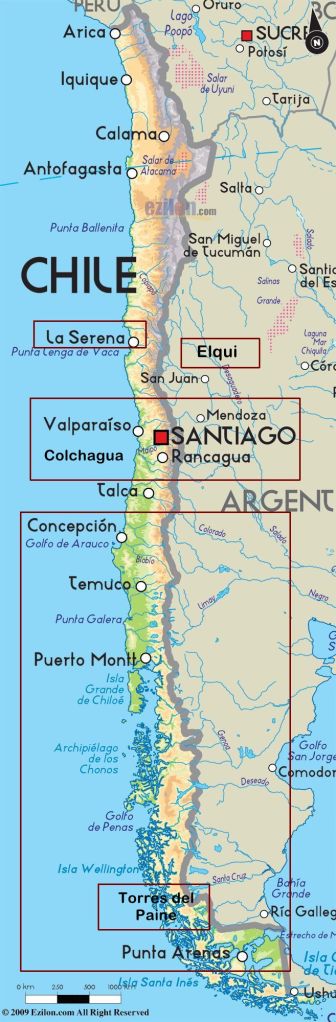
The Republic of Chile, is long and the narrowest country of the world, located along the western coast of South America, stretching approximately 2,700 miles from north to south. Chile covers a total area of about 756,102 square kilometers, which is approximately 291,933 square miles. This includes its mainland territory and claims in Antarctica. The country also controls several Pacific islands, including Juan Fernández, Isla Salas y Gómez, Desventuradas, and Easter Island. Compared to the western coast of North America Chile would go from Alaska in the north all the way down to Baja California, in Mexico. Naturally, Chile features diverse landscapes, including the Atacama Desert in the north, the Andes Mountains, and a Mediterranean climate in the central region, with a population of around nineteen million people and Santiago as its capital. Chile territory includes 480,000 square miles in Antarctica.
Chile is never more than 221 miles wide.
There are 3 distinct areas in Chile: The South including Patagonia, the canals and archipelagos of the fiords region, and the lakes and volcanos that make the region so famous; the central area which is the fertile agricultural area with its multitude of vineyards, orchards and vast kinds of produce and grains. This area also contains the major city Santiago, Chile’s capital, with a third of the country’s seventeen million population in 2008.
The North, which is an arid desert but has big surprises that I will tell you about later.
In the north, there are differences of 30 degrees between day and night. In the rest of Chile cloudy days and rain are predominant. This is due to the three mountain chains that run north to south in such a narrow country.
On November 16, 2008, we flew to Santiago from Dallas on American Airlines. The flight is nine and a half hours, so we arrived at 9:50 a.m. Chilean time at Aeropuerto Arturo Merino Benitez near Santiago. My cousin and her son came to pick us up and took us to her apartment in Las Condes, Santiago Area. We were ready in the afternoon for a two-hour bus tour of Santiago with a company named Turistik. Santiago was founded by Pedro de Valdivia in 1541. A study by Global Property Guide, which rates 112 cities in the world, ranked Santiago as the tenth most expansive city in terms of square meters. Santiago is rated the second-best city to live in in Latin America. The first is Sao Paolo in Brazil.
Santiago is a modern city. Beautiful modern buildings blend with traditional colonial and neocolonial styles. Many new constructions are taking up more space reducing the area of the valley ringed by high mountains. The city abounds with beautiful parks and plazas.
We begin our trip in the eastern sector of Santiago, at the mall Arauco Park, which is one of the most important shopping centers in the country. Within the tour in Santiago Oriente, we were able to see the beautiful Bicentennial Park or Parque Bicentenario, which is a large urban park in Santiago, Chile, covering 30 hectares and opened in 2007. It features artificial lakes, grassy areas, a Civic Center, and various recreational spaces. Then we continued through El Golf neighborhood and then to the Bellavista neighborhood. This is the bohemian artistic part of the city where painters, poets and writers get together. In this neighborhood is the entrance to the funicular to San Cristóbal Hill.
From Bellavista we continued to the historic center of Santiago. There we saw the Catedral Metropolitana, or Metropolitan Cathedral, the Central Post Office, the Casa Colorada, a beautiful colonial style house converted into a restaurant, and the Museum of Santiago. We saw the Former National Congress, the National Historical Museum, the La Moneda Palace, where the President lives, the Santa Lucia Hill where I learned how to roller skate, the San Francisco church located in the heart of Santiago. This Church was the first Catholic church built in Chile. It was established by Spanish conquistador Pedro de Valdivia in 1554 as a chapel that housed a polychrome sculpture of the Virgin Mary.
Next day we booked a tour to the Maipo Valley, 40 minutes from Santiago, and famous for its splendid vineyards. The first vineyard we visited was the Cousiño Macul. Then we went for lunch at the restaurant La Vaquita Echá, which means the laying cow, and we saw a show of Chilean folklore with cuecas, the national dance. Then we went to Viña Concha y Toro, famous for its wine Casillero del Diablo. We saw the Casillero, or locker, all illuminated in red showing a silhouette of the devil in the distance. (In 1966, the owner of the vineyard, Don Melchor Concha y Toro, spread a rumor that the devil lived in his wine cellar to deter thieves from stealing his prized wines. This legend has become a significant part of the vineyard’s identity.)
When we came back to Santiago that night, we went to a restaurant called Bali-Hai, near the house of my cousin, and saw folkloric dances from all regions of Chile and enjoyed a 4-course meal that included an appetizer, starter, main course, dessert, and wine refills. We saw natives of Easter Island dancing and many versions of the cueca, Chilote dances and others.
Next day we took my cousin on a tour of Casablanca Valley with Turismo Nuevo Mundo company. There we first visited the Veramonte Vinery, renowned for its wines like Sauvignon Bland and Chardonay. They also produce Pinot Noir and Syrah due to the cooling influence of the Pacific Ocean in that area.
We ate lunch at the Ristorante San Marcos in Viña Mar, and we continued to see the entire wine-making process at Casa Valle Viñamar, well known for its sparkling wines. Sauvignon Blanc, Merlot, Cabernet Franc, and Carmenere wines are also produced here.
Next day we flew with LAN airline to Concepción, the second largest city in the country and a major urban center. It was founded in 1550, and it has a rich history, significant industrial activity, and is home to several universities and cultural institutions. There we stayed at the Hostal San Martin. (This was a Bed and Breakfast place that we had had my cousin Eliana, who lives near Concepción, investigate before we made a reservation.)
My cousin Eliana came to visit next day and since we had rented a car at the airport, we took a tour through Concepción. We saw the Plaza de la Independencia, or Independence Square, and the University of Concepción, and I was glad to see again the black-neck Chilean swans in one of the city parks.
That day we visited the old coal mines at Lota. This is a historically significant place for its coal mining industry, which began in the 19th century and continued until the mines closed in the 1990s due to declining demand. As visitors we explored the El Chiflón del Diablo, which translates to the Devil’s Crackpots mine, a major tourist attraction, and the Historical Museum of Lota with children dressed in colonial outfits. It was good to visit the mine with a guide that had been a miner in that place. The mine is one mile deep beneath the ocean. It features a labyrinth of tunnels that extend for about half a mile underground. The guide told us how canaries were used in the Lota coal mines in Chile as early warning systems for toxic gases like carbon monoxide. If the poor canaries died, and miners ran for the outside. We also saw the houses of the miners and we learned about the two-bed system where one woman attended the needs of two miners, one during the day shift and another during the night shift in the mine.
We continued our visit at the Jardines de Lota, also known as Parque Isidora Cousiño, a historic park located in Lota that features a unique blend of French and English garden styles, with a variety of plant species and sculptures. It also offers magnificent views of the Pacific Ocean. We also saw the beautiful Parroquia San Matias Apostol or Church of San Mathias, the Apostle, in Lota.
Next day we went to visit my cousin and her husband who lived in San Pedro de la Paz, near Concepción. After our visit with my family, we continued to Talcahuano, Penco, and passed through Lirquén and Tomé. Penco was famous for Fanaloza, the ceramic factory, and Tome famous for its textile wool products of such excellent quality that were exported to Scotland to make kilts.
Next day we went to Chillán, a city where I worked in the Public Relations office of the University of Chile branch in that city. We saw the amazing Catedral de Chillán, a modernist Roman Catholic cathedral completed in 1960, known for its unique architectural design featuring ten arches that symbolize prayer. It serves as the seat of the Diocese of Chillán and is a significant cultural landmark, having been rebuilt after the devastating earthquake of 1939. We also visited the Mercado de Chillán known for its modernist architecture and vibrant atmosphere. It features a variety of local products, including the famous longaniza sausages, and serves as a cultural hub highlighting crafts and traditions from the region and beyond.
From there we continued driving and we stopped at a local vineyard, Tranque Viejo, and then we headed toward Colonia Dignidad, now known as Villa Baviera. It was a secretive colony in Chile founded by former Nazis, particularly a preacher, Paul Schäfer, who used it as a site for torture and murder during Pinochet’s dictatorship. It operated from 1961 until the 1990s and has since been transformed into a controversial tourist destination. One of my professors at the Journalism School at the University of Chile, Erika Vexler, was one of the first journalists investigating and publishing information denouncing what was going on at Colonia Dignidad. This started the first legal investigation of the colony between the years 1966 and 1968. But after the military coup in Chile, it was infamous because of the tortures of political prisoners.
Next day we continued our driving to the south, and we stayed at Cabañas Don Juan a wooden chalet located in the center of Villarrica. This town offered stunning views of the Villarrica Volcano and Lake Villarrica. We saw the Catedral, the Municipalidad, City Hall and the Museum in Villarrica and enjoyed the rustic charm of the city. Then we went for lunch at Hotel Antumalal, a luxurious boutique hotel located in Pucón, known for its stunning views of Lake Villarrica and Bauhaus-inspired architecture.
Next day we continued North. We stopped in Temuco, but the Museum I wanted Karelin to see was closed that day, so we continued to see Los Saltos del Laja or Laja Falls. This is a famous waterfall located in the Laja River in southcentral Chile. It lies next to the old Pan-American Highway, between the cities of Los Ángeles and Chillán. The river has formed a narrow canyon below the falls. There are four horseshoe-shaped falls, one on each arm of Laja River. The tallest is the easternmost fall, while the western falls are sixty feet tall. We had lunch there at a restaurant where we saw beautiful peacocks. We went back to Concepción and that night at the Hostal San Martin we met the owner, Señora Graciela. After a brief interchange about our common beliefs in Christ, we spend a long time in prayer for her good health and success in her business. After losing her job at the mines, she had started just renting rooms to help students from Curanilahue, her town of origin, coming to the University in Concepción. Little by little her house grew, and she offered lodging to tourists like us. Today the place has a website on the internet.
On November 26, we few back to Santiago. That night my cousin took us to Reñaca, a beach near Viña del Mar, where she had and apartment.
Next day we went to visit Quinta Vergara, a park located in Viña del Mar, featuring landmarks such as the Palacio Vergara, the Quinta Vergara Amphitheater, and a garden. It is also known for hosting the annual Viña del Mar International Song Festival. We particularly enjoyed the Palacio Vergara with the collection of famous paintings and gorgeous salons. Outside the Palace, we found a man playing the musical saw. It is played by bending the blade into an S-curve and using a bow to create sound along the flat edge.
We continued to see the Flower Clock, or Reloj de Flores, in Viña del Mar and saw all the most typical places in that area like the hotel restaurant Cap Ducal, Wulf Castle, the Casino, and the Brunet Castle. We drove to La Costanera right next to the Pacific. Then continued to Reñaca for lunch at Terraza de Alfredo, famous for its beautiful painted walls. We continued to Valparaiso. We first stopped at Plaza de la Victoria, a historic park in Valparaíso, Chile, named to commemorate Chile’s victory in the war against the Peruvian Bolivian Confederation in 1884. Then we drove to Valparaiso port. We saw the monument to Lord Cochrane, a British Chilean marine, to honor his contributions to the Chilean Navy during its independence. The we went to Plaza Sotomayor and saw the Intendencia building, which now houses the Chilean Navy. The plaza is also home to the Monument to the Heroes of Iquique, honoring sailors who died in battle.
At Muelle Prat pier, named in honor of one of the heroes of the War of the Pacific between Chile, Peru, and Bolivia, we took a ride on a boat to see the Valparaiso Bay considered the Pearl of the Pacific. On our boat ride we went on warships, cargo ships, cruise ships and luxury yachts. Coming back to the pier we visited the little shops and then we went to see La Sebastiana which is a house museum in Florida Hil in Valparaíso. The poet Pablo Neruda once owned it. It features unique architecture, stunning views of the city, and a collection of artifacts reflecting Neruda’s life and travels. We went by the St Paul’s Church, an Anglican church in Concepción Hill, admired the colorful house, stopped to rest at the Paseo Gervasoni, a popular “mirador” or observatory, and we used the Ascensor or funicular, built in 1883.
We returned late to Reñaca to find my uncle and my aunt at the apartment of my cousin. It was a happy meeting with my relatives.
Next day we all went for lunch at the restaurant in Cochoa Beach from where we could see the pelicans and seagulls waiting for the fisherman to give them part of the catch. The restaurant La Isla Cochoa is known for its stunning ocean views and fresh seafood dishes.
From there we went to visit the place of my cousin in Quebrada de Alvarado which was about 3 hours from Reñaca. We spent some time checking the place and continued to Santiago heading east from Quebrada de Alvarado towards the Andes foothills. We followed local roads that led into the mountains, which connect to Santiago. We thoroughly enjoyed the scenic views of the mountains, valleys, and small villages along the way. We also were surprised at how silent and tranquil Pushkin, the gorgeous Siamese cat of my cousin, was during the whole trip.
Next day we took a tour to the Colchagua Valley where my paternal grandparents and some of my family lived at that time. An extremely popular tour to this valley is called El tren del vino with means the train of wine. We visited the Casa Lapostolle vineyard. I understand that some of those vineyards used to belong to my grandfather, but he sold them to the previous owners of the land located in the Apalta Valley of the Colchagua Valley. The vineyard was founded in 1994 by Alexandra Marnier-Lapostolle, a descendant of the founder of the Grand Marnier cognac company, and her husband Cyril de Bournet. The winery is known for its commitment to sustainable practices and has gained international acclaim, particularly for its flagship wine, Clos Apalta, which has received top ratings from wine critics. They also produce Carménère, Cabernet Sauvignon, Merlot, and Cabernet Franc. Another notable wine is Le Petit Clos. We took a horse cart ride at the vineyard and enjoyed seeing the beautifully well-kept vineyards. We visited the warehouse and admired the huge wooden barrels full of wine. The shop is fabulous.
We saw the Museo de Colchagua in Santa Cruz village before we stopped for lunch at a very rustic and restful restaurant near Nancagua, where part of my paternal family still lives. We saw the cathedral where I was baptized, and we visited one of my cousins and his family who own a hardware store.
We continued to Casa Silva vineyard. In 1887 Emilio Bouchon Poitvin, originally from an area near Saint Emilion, in the Bordeaux region, France, emigrated to work as an Oenologist-Viticulturist at an important Santiago vineyard. It was at the beginning of the 20th century that, together with his children, he decided to start his own production of grapes and wines, planting the vineyards and the wine cellar that today houses Viña Casa Silva, in the Angostura Estate, near San Fernando. in the Colchagua Valley. We visited the original family home, where six generations of people lived, it is currently the Casa Silva Boutique Hotel. We also visited the wine warehouses and a great old cars collection.
We returned to Santiago on November 29. That time we had the opportunity to present our faith in Christ to my cousin, and she asked for prayer and accepted the Lord. I have been praying for my family to accept the Lord for a long time.
On November 30 we returned to Dallas on a flight that started at 11:15 p.m. in Chile and ended in DFW at 6:10 in the morning.
2011
Since Chile is exceptionally long and has many regions, we took another trip in October 2011.
This time we booked the flights with British Airways from Dallas to Santiago. But the flight was operated by American Airlines. We departed on October 2nd at 9:00 p.m. and arrived at 8:00 in the morning. This was a 10-hour flight.
The Scripture I carried for this trip was Luke 21:19. ‘By my [patient] endurance [empowered by the Holy Spirit] you will gain your souls.’ (“Luke 21:19 – Amplified Bible” 2019) My spirit submitted to God and my soul controlled by my submitted Spirit.
I had many things to talk to members of my paternal family about, and I needed all the self-control the Holy Spirit could give me.
We had a van waiting for us because we arranged with a tour company in Chile called Ruta Chile for all our transportation. We were taken to the apartment of my cousin where we stayed during our brief time at the capital.
This was our third trip to Chile. First, with our South America Cruise with Holland America, and then, our rented car tour around the areas of Santiago, Concepción, Chillán, Lake Villarrica, Valparaiso, and Viña del Mar, and Colchagua Valley.
This time I also connected with a cousin on my paternal side. She was happy to take us to visit La Vega Central and the Central Market in Santiago.
La Vega Central is also known as the Feria Mapocho, the river that runs through the capital of Chile. La Vega is a prominent market famous for its wide variety of fresh fruits, vegetables, and local cuisine. It spans almost forty square miles and features over five hundred stalls. It is mostly located in a covered building but also extends into the surrounding streets. It features direct sale of produce from grower to consumer. It was founded at the same time the city was founded in 1541.
El Mercado Central de Santiago, which opened in 1872, is an historic market in Chile. The market is in a building which features a cast-iron architecture, roof and supporting structure, which was fabricated by the Scottish firm R. Laidlaw & Sons, Glasgow. El Mercado serves as a hub for both locals and tourists, featuring a variety of fresh produce, handicrafts, and restaurants. It was one of my parents’ favorites places to eat typical food in Chile. My father had a friend and client, Don Simon, who owned a seafood restaurant. I absolutely loved the fried fish, the ensalada de repollo or coleslaw and the white wine served in a cup, not a glass. Don Simon enjoyed watching me eat his fresh food.
Karelin was quite impressed with the cleanliness of the Vega and the market and the beautiful displays of produce. The flower market was especially stunning!
Next, we went to visit the Museo Nacional de Bellas Artes. This is the oldest art museum in South America, established in 1880. It houses a significant collection of Chilean and international art, with its current building inaugurated in 1910, designed in a Beaux-Arts style. We went to see all the buildings around the Plaza de Armas, or main square of the city, also founded in 1541. The square is surrounded by historic buildings, including the Metropolitan Cathedral of Santiago, the Central Post Office Building, the Palacio de la Real Audiencia de Santiago, and the building that was formerly occupied by the Cabildo of the city before being remodeled. We also saw some architecturally significant buildings that face the square such as the Capilla del Sagrario, the Palacio Arzobispal, the Edificio Comercial Edwards, and the Portal Fernández Concha, which has many stores restaurants inside. The day we were at this square a group of children were dancing the national dance, la cueca, with the typical folkloric costumes. We ate good Chilean sandwiches at a restaurant inside the Portal Fernández Concha.
To move inside Santiago, we used the Transantiago, now known as Red Metropolitana de Movilidad, which is the public transport system serving the capital. It began operation in 2007, and it is considered the most ambitious transport reform undertaken by Chile. It combines subways with buses to form a highly organized system of transportation. Before, when I lived there, thousands of independent bus operators owned all the buses. We enjoyed how clean the service was and the gorgeous murals in every station of the subway.
After a visit with my cousin and her husband we went together the next day to Nancagua where my grandparents lived after selling the “fundo” properties. Fundo is equivalent of a ranch in Chile. We stopped to visit La Quinta de Tilcoco and the well-known Parroquia de Nuestra Señora de la Asunción there. The Maryknoll sisters have provided help to the community in this location.
On the road, we stopped at Juan y Medio, a famous restaurant that opened in 1947, to eat Pastel de Choclo, empanadas, baked turnovers consisting of pastry and filling; prietas, blood sausages made from fresh pig’s blood mixed with onions, spices, and walnuts; enrollado, seasoned pork rolled in pork skin and slow-cooked until tender; and other delicacies. It was a fantastic lunch.
We continued to the new house of my cousin and her husband in Nancagua. Right after arriving, we went to visit my grandparents and aunts tomb at the Cemetery where I saw the procession that started this writing. We saw the mausoleum of the family and the tomb of several dear friends in that area.
Then we went to see the effects of the 2010 earthquake at the house of my grandparents which my father had bought after my grandfather was not able to continue tending the ranch. The old colonial house built of adobe was destroyed. Only some walls were half up, but the gorgeous palm in the middle of the main patio, orange trees, other trees, plants, and flowers were alive and well. Even the arbor with grapes looked like it was without much damage. Other two of my cousins were also there to check the house.
We continued to visit the Cathedral of Nancagua where I was baptized. It was already well repaired by the entire community after the earthquake of February 27, 2010, 8.8 magnitude.
After a day in Nancagua we returned to Santiago. We need to continue our trip, this time to the north of Chile.
At six in the morning the next day, we took a taxi to go to the tour bus terminal right next to the main train station in Santiago. We headed to La Serena, a 293 miles distance. The trip lasted 6 hours nonstop.
La Serena was founded in 1544, it is the country’s second oldest city after the national capital, Santiago. The population in 2011 was about two hundred thousand. It is one of the fastest-growing areas of Chile. It is well known for its University of La Serena. It is the home of the Roman Catholic Archdiocese of La Serena, one of five Catholic Archdioceses in Chile. The city has twenty-nine churches and many call it “The City of Churches.”
We were transferred by van to our Hotel Club La Serena. Our room had a gorgeous view of the Pacific Ocean and the beaches in La Serena. That afternoon we walked around the city a little and we had dinner at the Hotel Restaurant Las Brisas with a splendid view of the beach. Our destination next day was the Elqui Valley.
The Elqui Valley is a picturesque wine region in northern Chile, located alongside the Elqui River and known for its sunny, desert-like climate ideal for agriculture and particularly for growing grapes. It is famous for producing high-quality wines, particularly pisco and varietals like Syrah and Sauvignon Blanc, and is also a popular destination for stargazing due to its clear skies and and lack of light pollution. It has numerous observatories. The surrounding Andes mountains provide a stunning backdrop.
Next morning we left on a bus to El Valley del Elqui. We stopped to see the Aeolian harp, a musical instrument played by the wind located at the Puclaro Reservoir in the Elqui Valley 43 miles from La Serena. The sound is magnificent.
Then we went to visit the Cooperativa Agrícola Pisquera Elqui Limitada or Pisco Capel, located in the Elqui Valley. It is one of Chile’s largest producers of pisco, a type of grape brandy. The cooperative was founded in 1938 and has grown to include over 1,200 members, producing a sizable portion of Chilean pisco. We learned about the historic origin of pisco and went through the entire process of the production of this delicious type of brandy only produced in Chile and Peru.
We had lunch in Villaseca at a restaurant called Antakari where meals are prepared using unique solar kitchens, or solar ovens. These restaurants utilize the region’s abundant sunshine to cook traditional Chilean dishes.
On the road we saw the amazing number of vineyards that characterize the zone. The wind whips so powerfully through this area that net screens are needed to protect the plants.
We arrived at Vicuña where we visited the Gabriela Mistral School or Escuela Gabriela Mistral. It is named in honor of this renowned Chilean poet and educator. She was the first Latin America writer to receive the Nobel Prize in Literature in 1945.
On our road back to La Serena we visited the Mamalluca Observatory which is a prominent astronomical observatory located less than 5 miles northwest of Vicuña in the Elqui Valley. It opened in November 1998 and is known for its excellent stargazing conditions due to the region’s clear skies. We saw several planets using the amazing 12-inch telescope. It is equipped with CCD detectors for electronic photography and is part of a larger educational experience for guests. We saw several galaxies and a full moon that night. We returned extremely late to our hotel in La Serena.
Next day there we visited the Archeological Museum of La Serena. It was founded on April 3, 1943, and specializes in archaeological collections from the Coquimbo region, including a notable moai from Rapa Nui (Easter Island). It features exhibits on various pre-Hispanic cultures.
We then took a good tour of the city and went to Coquimbo, founded in 1550, only six miles from La Serena, to admire the Cruz del Tercer Milenio or Third Millennium Cross, which stands 272 feet tall and 131 feet wide. It was completed in 2001 and is a significant symbol of Christianity in the region, offering panoramic views of the city from its location on El Vigía hill. That night we returned to Santiago on the same bus line.
Back in Santiago we went to visit the Parroquia Divina Providencia dedicated to the Divine Providence and that gave the name to the Providencia neighborhood. Again, we took the subway and went to visit the Palacio de la Moneda. We had a special appointment to have a guided tour.
La Moneda was built between 1784 and 1805, it originally served as the mint of Santiago, hence its name (“La Moneda” translates to “The Coin”). It is an ornate neoclassical building that became the presidential palace in 1925 and has been the site of many pivotal events in Chilean history. As visitors we could explore its inner courtyards and learn about its history, including its significance during the 1973 military coup that overthrew President Salvador Allende. Part of the building was destroyed but it has been repaired.
For lunch we had hotdogs “a la chilena” at restaurant Domino. Then we had a visit with my cousin and her husband and another of my cousins and his wife and son.
They took us to the airport on October 16 and we flew back to Dallas on American Airlines arriving at 6:00 in the morning on October 17, 2011.
I wrote separately about the trip we did to Chile in 2015 with the members of our Travel Club.
2016
Other especially important places on our bucket list were Torres del Paine in Patagonia, and Isla de Pascua in Chile. So, we decided to call Andres at Patagonia Southern Land Expeditions and ask him to give us an estimate for the complete trip.
After several emails, we decided that he should make plans for Patagonia, and we would deal with Easter Island.
So, in 2015 we decided to go to the gym at The Summit 55+ in Grand Prairie, hire a trainer and prepare for the trekking in Patagonia. We slowly improved in our one-mile time per day.
We departed on November 4. 206 miles from Dallas on United Airlines to Houston, from Houston to Bogota, Colombia, and from Bogota to Santiago, Chile. We arrived in Santiago at 7:15 a.m. on November 5th. We stayed again at Hotel Oporto, the hotel we had used on our previous trip with the Travel Club.
Next day we went to see the cousin I had stayed with before. She was feeling very weak and depressed, so we prayed with her.
Next day we flew with LATAM (the Chilean airline) to Punta Arenas in the very south of Chile. We arrived in the afternoon and a friend of Andres who had a taxi picked us up and took us to Puerto Natales.
It was a three hours drive with excellent views of this part of Patagonia, Chile.
Puerto Natales was founded in 1911; it is known as the gateway to Torres del Paine National Park and has transitioned from a sheep industry port to a popular tourist destination. A statue of the Milodón greeted us at the entrance of this little port. (The milodón was a very large prehistoric sloth-like creature which inhabited this area.)
We stayed in a charming and rustic hotel called KAU Patagonia located on a corner. We had a magnificent view of the Señoret Channel. The water was a little agitated that day because of the wind. We walked around the port, and we had dinner at the bar in the hotel.
We woke up the next day and just in front of our windows were two black neck swans having their breakfast at the channel. A bus picked us up at 7:30 a.m. to take us for a full day excursion at the Torres del Paine National Park. Our first stop was at the Milodón Cave, a natural cave famous for the discovery of remains of the extinct ground sloth, Mylodon, in 1895. Then we stopped at Lake Sarmiento. On the road we saw our first guanacos peacefully grazing. Guanacos are a camelid native to South America, closely related to the llama. I had the opportunity to take a video of a guanaco taking a sand bath just in front of me. He was a little shy!
Then we continued to see the famous Chilean Flamingos at Laguna Amarga. They are known for their pink color. They feed on small crustaceans and algae in these habitats.
We had the stunning view of Cuernos del Paine in the background while we crossed the bridge to go for lunch at Hosteria Pehoe. It was like a dream!
At the end of the excursion, we were taken to our Hotel Serrano for the night. We had perfect pictures of Torres del Paine being bathed in by the sun.
Next day was our main adventure. We were taken to Lake Grey to see glaciers. These are still at Torres del Paine National Park. The bus took us to the beginning of the one and a half mile walk necessary to get to the ship to navigate the Lake. This walk was the one we have been preparing for at the gym. It was hard. The path goes on coarse volcanic sand and is not well-marked. It is mostly flat, but there were some uneven sections, rocks, and roots along the way. Leaning hard on our walking sticks, we made it to the pier of the boat on time. It was quite full of young people already. However, Andres has bought tickets for us, and our seats were secured. We navigated for about 3 to 4 hours on the lake. We reached the border of the glacier, and everybody was crazy taking videos and pictures of the unbelievably beautiful scenery around us. One of the crew members cut some ice out of one of the icebergs floating on the lake and made Pisco Sour with the ice. Pisco Sour is our national beverage in Chile.
When we arrived back at the pier, we had to walk again the 1.5 mile trek to reach our bus. This time an absurdly strong wind was blowing, and we had to walk against it. I walked arm in arm with Karelin. We were trying vainly to pick up the pace because the bus at the parking place would be departing very soon. Karelin, out of breath, stopped and told me to go ahead and tell the driver to wait for her. At that very moment, out of nowhere, two girls dressed in their trekking clothes, saw Karelin having trouble and taking one arm of Karelin each, they practically carried her the rest of the path. Promptly, after they deposit her at the bridge across the parking place, they disappeared. We knew they were two angels helping us.
The bus took us to Hotel Lago Grey. We sat at the bar, which offers stunning views of Lago Grey and the nearby Grey Glacier, and observed people still having trouble with the wind on the path we had just done.
Back at our Hotel that night we saw people watching TV news about the elections in United States. We had voted earlier.
Next morning we learned that against all odds Trump had won the election. We were incredibly happy! We were picked up after lunch by Andre’s friend to go back to Punta Arenas and then take the plane back to Santiago at 6:00 p.m. On the road as we did during all our time in southern Patagonia, we saw many sheep, and many birds including the Magellan geese, queltehues, and many other birds that only exist in there.
We arrived in Santiago at midnight and were transferred to the Hotel Oporto only to learn that we did not have reservations. However, Hotel Oporto receptionist told us not to worry and called a taxi to take us to another Hotel nearby.
Next day we went to downtown Santiago, and we saw the “Cambio de Guardia” or Changing of the Guard. It takes place at La Moneda Palace every other day at 10:00 a.m. The ceremony features mounted units, a military band, and a formal handover of duties between the outgoing and incoming guards, highlighting Chilean traditions and military honor. To my surprise many female Carabineros were participating either on foot or mounted on the gorgeous horses.
Back in the Providencia neighborhood we went up Sky Costanera which is the highest observation deck in Latin America, located atop the Gran Torre Santiago, which stands at 984 feet tall. It offered us breathtaking 360-degree views of Santiago and the Andes.
That night we went back to Hotel Oporto where we were going to stay for 3 more nights.
Next day my paternal cousin took us to Quebrada de Alvarado where we visited with one of my maternal cousins, his wife and son at their summer cottage. We had a lot of fun watching the reaction of all the dogs every member of my family owns.
Back to Santiago next day I invited several members of my paternal family to see me at the Oporto Hotel where we had the traditional Chilean tea or onces.
Next day we were taken to the Airport and flew on a LATAM flight to Easter Island or Rapa Nui. The flight is 5 hours and 25 minutes. There the owner of Kahina Lodge, our hotel was waiting for us with the traditional luaus. He was genuinely nice and offered to help us with anything we needed and took us to our rooms. It was a lovely but modest place surrounded by banana trees and many plants and gorgeous flowers.
After settling at the hotel, we went to the tourist company we have contacted by email to confirm all our plans. We had booked four tours on the island with the company Mahina Tours.
That night we went to Te Moana, a restaurant on the beach just 5 minutes from the Hotel. I enjoyed the most flavorful ceviche.
It is important to know that the whole of Eastern Island is a National Park and belongs to the region of Valparaiso in Chile.
Next morning the plan was to go to Akahanga, Tongariki, Rano Raraku, Te Pito Kura and Anakena beach. We ended up doing a different tour. This was highly informative but not a happy one.
When we started the tour, our guide did not introduce herself or the driver as other guides do. Her name was Emilia Tepano. From the beginning she was not happy with our pace.
We first stopped at Rano Raraku quarry, a volcanic crater, extremely hard for us to climb as fast as the rest of the group did. In fact, Karelin could not go up and stayed behind waiting for the group to come back. When the guide asked us to hurry up, I approached her, and I told her: “When you reach my age you will understand why I cannot hurry up”. She did not answer. The climb to see the Rano Raraku Crater Lake was even more demanding and Karelin could not follow. When I finally arrived at the top to see the lake, totally out of breath, the guide had already ended her talk about it and the group was going down.
At this place it was amazing to see how the moais, the big Easter Island statues, were carved directly from the rocks. Among the many we saw the famous Moai Tukuturi. Approximately 95% of the moai were created from the volcanic tuff found here, and many unfinished statues remain in the quarry today.
We continued to Ahu Akahanga which is a significant archaeological site. These ruins include the tomb of King Hotu Matu’a and several toppled moai statues. The site features a platform with thirteen moai, which are decorated with red stones and hieroglyphs. Again, our guide walked as a bullet to the place we were visiting and waited for the bulk of the group to arrive to start her talk. We hardly made it here.
We then stopped at Ahu Tongariki. This is the largest ceremonial platform on Easter Island, featuring fifteen impressive moai statues, some of which are among the heaviest ever erected. The site has a rich history, having been restored after being damaged by civil wars and a tsunami in the 20th century.
After lunch, we continued to Te Pito Kura, also known as the “Navel of the World.” It is considered as a significant archaeological site. It has a large stone platform and the largest moai ever erected, known as Paro, which stands about ten meters tall and weighs around eighty-two tons. The site is considered sacred and holds cultural importance for the Rapa Nui people. Just beyond that oversized moai is a large egg-shaped stone called the “navel of light.” According to legend it was brought over by Hotu Matu’a, the founding king of the Rapanui people because of its special energy, or mana. The stone has a high percentage of iron content which is activated by heat and will throw off a compass if it is put too close. We were informed that many dark oriented groups from all over the world come to this point certain times of the year to perform demonic ceremonies at this precise place.
We ended up at Anakena, a beautiful white coral sand beach located on Easter Island, known for its calm turquoise waters and palm trees. It is historically significant as the landing site of the island’s first king, Hotu Matu’a. At the beach gardens there are several moai statues, including Ahu Nau Nau, which features seven moai, two of which have deteriorated. These are the most detailed moais on the island.
At this place we had an uncomfortable situation. When we arrived at Anakena beach the guide got off the bus without telling us where we were until we arrived near the moais. Since Karelin could not go all the way to the place the guide was, she was left behind.
At the end of her talk at the site Emilia told us that we would take the bus back to another place in another hour and a half. Of course, Karelin left behind was not informed about it. My friend had gone back to where we entered Anakena beach, but the bus had already moved, and nobody was there to inform her about it.
When the guide told us that we were supposed to go to the restaurants at the beach and stay there for one hour and a half more I told her that Karelin did not know that and that I did not know how to find her. Emilia told me literally: “That is not my responsibility, I care about the group and not about individuals”. Her attitude was very ugly and condescending.
I then tried to find the driver of the bus going to all the restaurants in the area and finally I found him near where the toilets were. He said that perhaps my friend was where he had dropped off the group. So, I had to walk all the way back to the entrance of Anakena beach and find my friend that was totally by herself. She had started to walk toward the buildings she could see in the distance without knowing that those were the restaurants at the beach. When Karelin confronted the guide, she was very insolent and said that she had done everything perfectly.
When we arrived at the bus, I texted the emergency number for Manhinatur saying that we did not want Emilia as our guide for the next day tours.
After this incident we went back to our hotel and had a good night’s rest.
Next day, this time with a genuinely nice attentive guide, we went to Humedal Ranu Kau, a wetland located within a volcanic caldera. It has a variety of vegetation and microfauna. This unique ecosystem is part of the crater lake, one of the few natural sources of fresh water on Easter Island.
Then we continued to see Motu Nui, Motu Iti, and Motu Kao Kao. Three small islets located off the southwestern coast of Easter Island. This is where the Tangata manu, or winner of a traditional ritual competition on Rapa Nui, goes to collect the first sooty tern egg of the season from this islet, he swims back to Rapa Nui, and climbs the sea cliffs of Rano Kau to the clifftop village of Orongo.
Orongo village is a ceremonial village located on Easter Island, known for its unique stone houses and its historical significance as the center of the Birdman cult. The village features a collection of low, round-walled buildings where the villagers slept. It is located on the edge of a volcanic caldera, overlooking the ocean and the nearby islet.
Our next stop was Puna Pa, a prehistoric quarry on Easter Island known for its red scoria, which was used to carve the topknots (pukao) for the island’s iconic moai statues. It is located near Hanga Roa which is the city where our hotel was. This place was full of Moais hats, many carved with interesting hieroglyphics.
We continued to Ahua A Kivi known for its seven identical moai statues that face the ocean. It is also recognized as a celestial observatory, with the statues aligned to mark the equinoxes. In this area we saw people working in the fields. Agriculture and raising of cattle are common on the island.
I went in at Ana Te Pahu, a significant cave on Easter Island. Its lava tube formations were once used as dwellings by the ancient Rapa Nui people. The cave features a unique environment with high ceilings and is often referred to as the “drum cave” due to the sound created by its volcanic walls.
That night we attended a typical curanto traditional Rapa Nui, also known as Umu Rapa Nui. It is a traditional dish that features well-cooked fish, and several types of seafood layered with potatoes, all prepared using hot stones and covered with banana leaves. This cooking method reflects the island’s unique culinary heritage, combining local ingredients and techniques. We had our faces painted with Rapa Nui symbols before the curanto. We also saw a fabulous dance show. We learned, and we could see it in the dances, that Rapa Nui people share cultural and linguistic similarities with the Māori in New Zealand.
At Easter Island we had the opportunity to visit with missionary friends from United States that have lived many years in Easter Island learning the Rapa Nui language, making dictionaries and translated the Bible to the language. They helped schools teach their language to the young people to preserve it for coming generations.
They told us that the people of Rapa Nui are quite reserved in general. They have experienced their culture invaded by tourists with no respect for their habits and customs so they could seem unfriendly.
Next day we returned to Chile on a flight that lasted more than 6 hours. Back at the Hotel Oporto we packed our bags and the next day we flew back to Dallas.
Out flights started on November 18, 2016, from Santiago to Mexico, Mexico to Houston and Houston to Dallas. We arrived at 4:00 p.m. November 19th.
2020
Our fourth trip to Chile was in February 2020, right before COVID closed all opportunities to travel that year.
We first did a cruise from San Diego to Fort Lauderdale cruising Panama Canal. At the end of that cruise on February 5, 2020, after disembarking in Fort Lauderdale, we took a taxi to Miami Airport and departed at 10:50 p.m. to Santiago on American Airlines.
We arrived in Santiago at 9:40 a.m. on February 6. We took a taxi to Santa Cruz in Chile. We did not even think to go to Santiago this time because there were multiple disorders taking place at the capital of Chile, and it was practically destroyed.
In 2019 there were a series of massive demonstrations and riots called “Estallido Social” or Social Blowups in Chile. The protests occurred between October 2019 and March 2020, in response to a rise in the Santiago Metro’s subway fare, the cost of living, university graduate unemployment, privatization, and social inequality prevalent in the country. The problems started in Santiago, the capital, as a coordinated fare evasion campaign by secondary school students. This led to irresponsible takeovers of the city’s main train stations and open confrontations with the Carabineros de Chile, the police. Statues were painted or destroyed; parks and public places were smashed. Many other major cities and towns suffered riots.
However, the Lord protected us at all moments. I carried this scripture on my phone specifically for this trip.
25 “I, only I, am He who wipes out your transgressions for My own sake,
And I will not remember your sins.
26 “Remind Me [of your merits with a thorough report], let us plead and argue our case together;
State your position, that you may be proved right. (“Bible Gateway Passage: Isaiah 43:25-26 – Amplified Bible” 2019)
I had rented an apartment at InTown Apart for a week in Santa Cruz. I was going for family related matters; I needed some time to get together with family and lawyers.
On February 7th we took a walk in the city. Santa Cruz is a city located in the Colchagua Province of the O’Higgins Region in central Chile. It is well known for its rich history, beautiful landscapes, and as a center for wine production. The city is also known for an important casino where big money changes hands.
The region surrounding Santa Cruz is famous for its vineyards and wineries, making it a popular destination for wine tourism. The area is characterized by stunning landscapes, including rolling hills, vineyards, and the Andes mountains in the distance. My grandfather had worked providing wines such as Carménère, Cabernet Sauvignon, and Syrah from his vineyards to many important vineyards in the area.
We visited the city hall or Municipalidad which was in a gorgeous red colonial building. We enjoyed sitting at the Plaza or square in beautiful and sunny weather. That afternoon I went to some meetings while Karelin continued enjoying a walk in the city.
Next day we went to visit the Museo de Colchagua located in Santa Cruz. This is one of the most significant museums in the country, renowned for its extensive collection that highlights the history, culture, and heritage of the Colchagua Valley and Chile as a whole. It exhibits archaeological artifacts, colonial-era items, and objects related to the indigenous peoples of Chile. It also features collections on the agricultural and industrial history of the region.
The Museum offers educational programs and guided tours. That day we found out that the Museum had created a new special pavilion to show “The 2010 Rescue of the Chilean miners”.
This rescue of the “Copiapó mining accident,” occurred in 2010 when 33 miners were trapped underground in the San José copper-gold mine near Copiapó, Chile. The miners were trapped for 69 days, from August 5 to October 13, 2010, after a cave-in blocked their exit. To our surprise one of the miners, Juan Illanes, was there to give a first-hand account of what happened during that tragic incident. The Museum displays objects, photos, films, simulated tunnels, and tents for the families waiting outside the mine. All related to the dramatic rescue of thirty-three miners trapped underground in 2010. This exhibit highlights the miners’ survival story, and the efforts made to bring them back to safety.
Talking to Juan was like reviving the complete tragedy these miners went through. We learned where he was when on August 5, 2010, the cave-in occurred, trapping the miners approximately seven hundred meters (2,300 feet) underground. He told us that the initial rescue efforts focused on locating them and assessing the situation, but they did not know if anybody was searching for them. On August 7, it was a second collapse. The men spent 17-days without contact with the surface. They subsisted on a supply of emergency rations intended to last 2 days, taking meals only once every other day. Water was obtained from a spring and from radiators. On August 22, rescuers contacted the miners through a tube they had managed to drill into the area where they were.
A massive international rescue operation was launched, involving engineers, geologists, and rescue teams from various countries. The rescue plan involved drilling a larger hole to bring the miners to the surface. “Plan B” involved using a specially designed capsule called the “Fénix” to lift the miners one by one. On October 12, 2010, the rescue operation began, and the first miner was brought to the surface. The operation continued over the next 24 hours, with all thirty-three miners successfully rescued by October 13.
The incident raised awareness about mining safety and led to changes in regulations and practices in the mining industry in Chile and beyond.
We told him how much we had been praying for them during all that time while we were with our eyes fixed on our TV, looking at all the efforts being made to rescue them. Juan thanked us, saying “We all knew that only our prayers and the intercession of people around the world will save us.” He was very touched knowing that we have prayed for him.
We saw the rest of the Museum with a lifted spirit.
Next day we went for a tour at Viña Santa Cruz, a vineyard were the queltehues birds greeted us with their warning sounds. Queltehues are the guardians when dogs are not around. We walked around to see the vineyards and saw the process of making wine. We enjoyed a cable car ride that offers stunning views of the vineyard and the surrounding landscape. The ride culminated at the Hill of Cultures, where we learned about the local indigenous cultures such as Mapuche, Aymara, and Rapa Nui. We also had the opportunity to pet a vicuña. Also enjoyed the car collection at the vineyard.
Viña Santa Cruz has been recognized for its sustainable practices since 2011 and became 100% solar powered in 2017. Their recognized wines are Chamán Reserva and Chamán Gran Reserva with the varieties Cabernet Sauvignon, Carmenere, Syrah, and Sauvignon Blanc. We had an excellent meal at the restaurant.
February 10 was full of meetings for me and more walks for Karelin who enjoyed taking pictures of the bougainvillea, roses, chilcos, and many other plants and flowers around Santa Cruz.
Next day was my birthday and the day my family meetings ended. Karelin and I celebrated my birthday at Club Union Social; this is a center and restaurant that was founded in 1913. It has served as a social and cultural hub for the community, providing various activities and events for its members over the years. The club is known for its historical significance in the region. My grandparents and my parents have been there several times while I was growing up in Chile. Karelin and I sat under the most beautiful grape arbor of Uva Pais which was one of the favorites grapes of my grandfather. We celebrated with an excellent wine and a typical churrasco, an incredibly good meat sandwich.
Next day we visited the Parroquia de Santa Cruz, Parish of the Holy Cross, located in Plaza de Armas, the square, and the parish of Sagrado Corazón de la Isla de Yáquil, located in the rural sector of the same name.
Next day our taxi took us back to the airport and we flew on February 13 on American Airline at 10:30 p.m. arriving at Dallas at six in the morning of February 14. During the trip, they told us about COVID.
That was the last time I was in Chile.
 An Ear by Mistake
You must be logged in to post a comment.