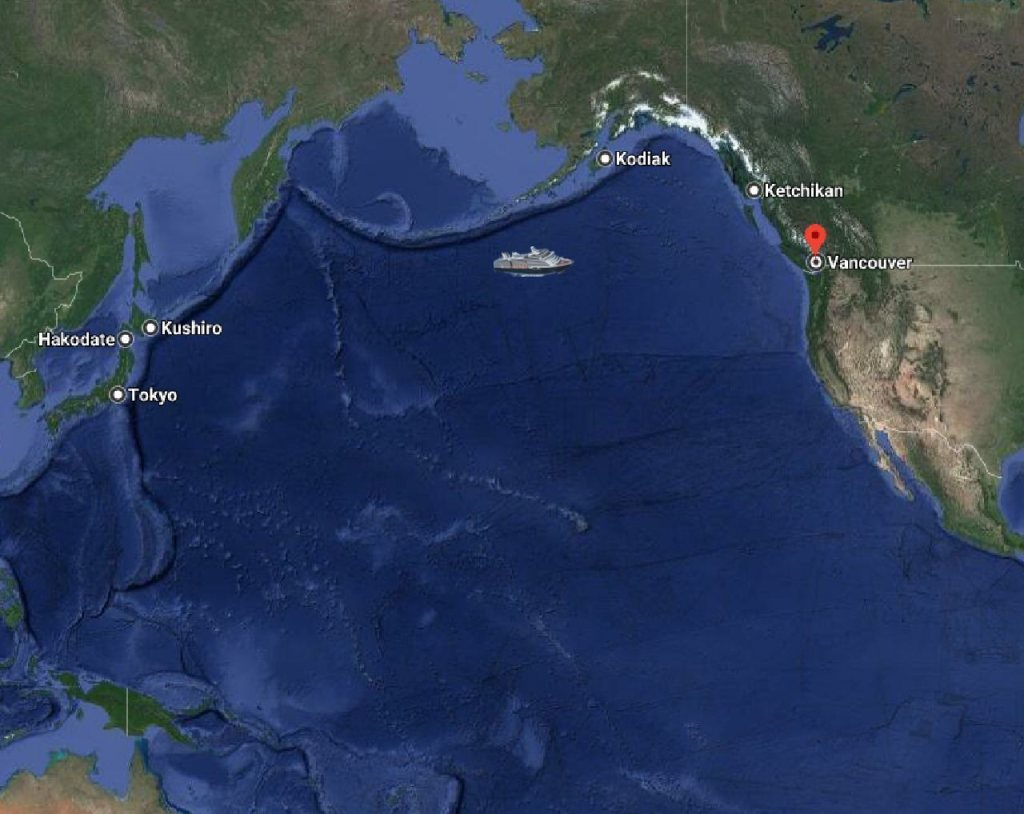
This cruise with Holland America was entitled “15 days North Pacific Crossing”. It was a transpacific cruise going from Tokyo, Japan to Vancouver, Canada. The dates were from April 25 to May 9, 2018, and the ship was the MS Volendam.
We wanted to at least see a bit of Japan so we flew with American Airlines to Los Angeles and then to Tokyo on April 22. After arriving in Tokyo on April 23 in the afternoon, a bus from the hotel we had booked picked us up at the Narita airport.
It is important to note that my Scripture for this trip was: John 14:27. “Peace I leave with you; My [perfect] peace I give to you; not as the world gives do I give to you. Do not let your heart be troubled, nor let it be afraid. [Let My perfect peace calm you in every circumstance and give you courage and strength for every challenge.]” It helped us to stay calm during the next day. (“John 14:27 – Amplified Bible” 2019)
We have made a reservation at the Okura Prestige Tower Hotel in Minato-ku, Toranomon, Tokyo. The bus transfer from the airport to the hotel took about an hour.
The reason for selecting this hotel was that the Gray Line Toor Bus would pick us up right at the door of our hotel for the tour we had booked. It was a full day Gray Line Tour of Tokyo for April 24, 2018. The hotel was luxurious–gorgeous, grand lobby and excellent restaurant.
So, early next day we waited for a bus but instead we were picked up by a taxi! While we were waiting for the bus, we saw some commotion outside the hotel, and I went to take a video. On April 24, 2018, U.S. President Donald Trump and North Korean leader Kim Jong-un visited the Hotel Okura in Tokyo. This meeting was part of the diplomatic efforts leading up to their historic summit later that year. Of course, we did not have any idea about this when we booked that hotel for that exact date.
The taxi that came, after the limousine caravan had left its important passengers at the hotel, took us to another hotel, the Dai-ichi, a five-minute drive. There was no explanation, but later we understood it was because of the diplomatic meeting. We boarded the bus there. Our first stop was the Tokyo Tower, 1092.52′ feet’ tall. It is a communications and observation tower inspired by the Eiffel Tower and completed in 1958. We took a tour of the Top Deck where we saw panoramic views of Tokyo, including landmarks like the Tokyo Skytree and the Imperial Palace, but it was too cloudy to see Mount Fuji.
We continued to a beautiful Shinto shrine called Meiji Shrine built in 1920. It is dedicated to Emperor Meiji and Empress Shoken, who played significant roles in the modernization of Japan during the Meiji Era (1868-1912).
We drove by the Tokyo Imperial Palace which was once the Shogun’s fortress during the Samurai era, the National Diet Building or bicameral legislature building. We went by Harajuku, the trendy fashion stores area and Shibuya Crossing. We stopped and visited the amazingly beautiful Tokyo Imperial Palace East Garden. This is a historic garden built on the ruins of Edo Castle. It features beautiful landscapes, moats, and remnants of the castle’s defensive structures. We saw swans and colorful koi fish in the ponds and amazingly beautiful plants and flowers. On our way to our included scenic Sumida River Cruise to Asakusa, we drove by the Samurai Cruise Ship which is a replica of the vessel Atakemaru. The boat ride offered stunning views of Tokyo’s skyline, including landmarks like the Tokyo Skytree, the Rainbow Bridge, and various parks along the river.
We also went to Ginza, an upscale shopping, dining, and entertainment district in Chūō, Tokyo. The bus also circled around the Imperial Palace in Tokyo, which was once the Shogun’s fortress during the Samurai era.
We were supposed to go down and stroll but, since it was a rainy day, we just drove by the famous Nakamise shopping street. We arrived late at the hotel and were surprised by a an illuminated bright green Christmas tree, just-installed that day, at the entrance.
Next day we took a one-hour taxi to the Yokohama Cruise Port, Osanbashi Pier.
We embarked and after the safety drill we departed at four p.m.
We spent a day at sea and arrived at Hakodate. This third largest city in Japan is on Hokkaido Island, Japan. It was Japan’s first city to open its port to foreign trade in 1854. We took a taxi to visit the Goryōkaku Tower in Hakodate and saw stunning views of the star-shaped Goryōkaku Fort and the surrounding area. The tower is 351′ high. We also visited the famous cherry blossom area in this city. We continued on to visit the Japanese macaques at the Tropical Botanical Garden where they enjoy bathing in hot springs during winter. We were disappointed with the poor maintenance of this place. The macaques were not happy. We also saw plants, flowers, and koi fish. This time it was a nice girl that drove the taxi. She did not speak a word of English.
On April 28 we docked at Kushiro; this port is also on Hokkaido Island. Here we went to the Kushiro Tancho Crane Reserve, a dedicated area for the conservation of the Japanese crane, we observed these majestic birds in their natural habitat. We could not resist getting a souvenir here.
After a day at sea, we crossed the International Dateline on Sunday, April 29, and continued navigating until May 4 when we arrived at Kodiak, Alaska. We enjoyed those sea days on board because the cruise on the Bearing Sea has amazingly beautiful scenic views of the rugged coastlines and pristine landscapes. We saw stunning glaciers and dramatic fjords that highlight the natural beauty of the region approaching Alaska.
On board we also enjoyed several lectures and activities, especially a wine tasting occasion led by our favorite sommelier in Holland America, Bernardo from Philippines.
Docked at Kodiak Island, we learned that is the largest island in Alaska and the second largest in the United States, covering approximately 3,670 square miles. It features a diverse landscape that includes rugged mountains, lush forests, and pristine coastlines. In Kodiak we visited the Military History Museum located at Fort Abercrombie State Historical Park. It highlights the area’s military history, particularly its strategic role during World War II. The museum features exhibits on communication equipment and military artifacts and is run by local volunteers.
Then we visited the Baranov Museum to examine its eclectic mixture of Native, Russian and American exhibits. We also saw much information about the wildlife.
Back at the port, we had the opportunity to take a video of an interesting scene. It was a fishing boat docked at the pier. It had a ramp on the back that reached the sea. Apparently, the boat also had some fish left that attracted not only many eagles, that made a lot of noise and perched on the boat cables, but also attracted a sea lion that jump up the ramp of the boat and joined the eagles in the feast.
Another day at sea and we reached Glacier Bay Basin, Alaska. We spent two days here. We first had a guide that came on board to tell us about the area, and then next day we went into the surrounding mountains and glaciers with our guide. She was a member of the Huna Tlingit natives, who have lived in the area for thousands of years. In her beautiful language, then translated to English, she told us about how this indigenous people experienced significant changes due to glacial advances but have maintained a strong cultural connection to their homeland, known as S’e Shuyee.
We saw mountain goats at a distance, gulls, cormorants and other birds, sea lions and seals taking the sun near the glaciers. We saw Margerie Glacier, known for its impressive calving events, where chunks of ice break off and fall into the bay; the Grand Pacific Glacier which is larger; and the Johns Hopkins Glacier.
Next day we docked at Ketchikan, Alaska. Here we took an excursion to learn the history and culture of Ketchikan, traveling aboard a festive trolley. We were entertained by our lively guide while passing by some of the city’s most colorful landmarks. We went through downtown Ketchikan and passed the bustling boat harbor, lush City Park and beautiful Ketchikan Creek. We saw majestic totems up close. We went to Creek Street, which is Ketchikan’s historical red-light district. We had free time to explore Creek Street on our own. While there, we enjoyed watching the details of The Rock, a bronze sculpture created by artist Dave Rubin and unveiled on July 4, 2010. It features seven life-size figures representing the town’s history, including a Tlingit woman, a logger, a fisherman, and a miner, among others. The trolley driver offered us a return ride to the ship at that point.
Next, we crossed the Inside Passage, the coastal route that stretches about five hundred miles, featuring a network of waterways among numerous islands and fjords. We weaved through the islands on the Pacific Northwest coast of the North American Fjordland. This route extends from southeastern Alaska in the United States, through western British Columbia in Canada, to northwestern Washington state in the United States.
We arrived in Vancouver on May 9 and flew United Airlines to Denver and then Dallas.
A dream cruise but the weather was quite wet.
 An Ear by Mistake
You must be logged in to post a comment.