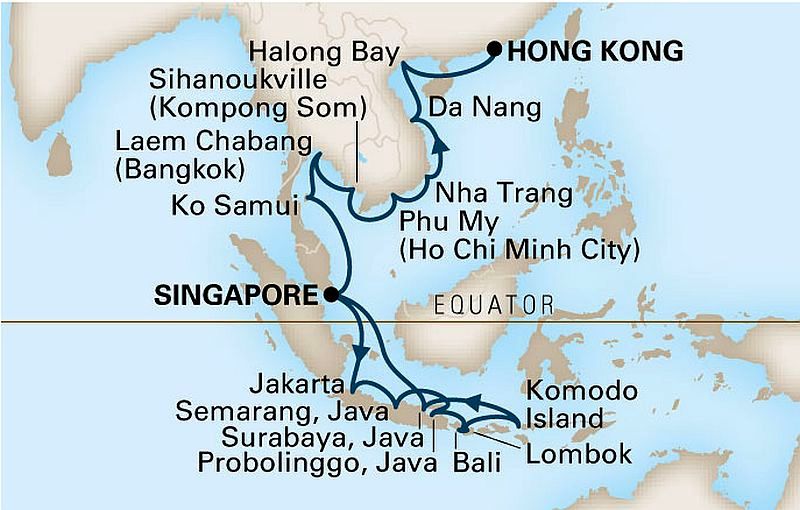
This was another long cruise. The “28-Day Indonesian Discovery & Far East Discovery Collector” by Holland America. Our ship was the MS Volendam. It would start in Singapore and ended in Hong Kong.
The best prices we could get for flying to Singapore were with Emirate Airlines and, to our delight, it included a stay on a hotel in Dubai before the final flight from Dubai to Singapore.
Holland America was going to provide the visas for several of those countries and since U.S. citizens do not need a visa for visits to Hong Kong for periods of up to 90 days, and we had previously obtained a visa for China, we decided to stay in Hong Kong for two extra days after our cruise. In July 2015, in fact, we booked the two nights at The Imperial Hotel for February 2-4, 2016. We knew better than to wait to try to make hotel reservations in high demand tourist cities.
All our documentation for the trip from Holland America came around October 2015.
My Scripture-related reflection for this trip was based on a sermon I heard about Punctuation Marks base in James 4:14. by Dr. L. Ronald Durham.
“A Comma is like sleeping at night. Taking a break. Going for lunch. Reflect. Listen to music. Prayer. Morning devotional. Pause that refreshes and renew.
A Period is a Full Stop. There are times in life when we need to do this. Change bad habits. Divorce. Renew or end a relationship. Heart surgery. Loved one die.
A Question mark is inquiring. Need for information. Children are not afraid to ask questions. Paul said to ask questions. Test everything, don’t believe everything. Thomas asked questions.
An Exclamation Point is like enthusiasm. Enthusiasm in God. Let your light shine.
What kind of example are we giving?” (Durham 2000)
We flew on January 3rd, 2016, from Dallas to Dubai. It was a flight of 15 hours. We arrived around noon in Dubai. The first thing we saw in our 10-minute drive from the bus to the hotel was the Burj Khalifa Hotel which is the tallest building in the world with 2,717 feet. As soon as we arrived at the Dubai Grand Hotel by Fortune, instead of using our free room, we hired a Grey Line tour that took us back just in time for the bus to pick us up from the hotel and take us to the airport to continue to Singapore.
During the tour, after seeing some of the city we stopped at the Dubai Mall, one of the largest shopping centers globally with luxurious shops. We also stopped at Jumeirah Beach for a quick photo opportunity with the iconic Burj Al Arab in the background. This luxurious hotel is often referred to as the “only seven-star hotel in the world.” Then we stopped at Palm Jumeirah. This is an archipelago of artificial islands on the Persian Gulf in Jumeirah, Dubai, United Arab Emirates. It is part of a larger series of developments called the Palm Islands, including Palm Jebel Ali and Dubai Islands, which when completed, our guide told us, will together increase Dubai’s shoreline by a total of 325 miles.
Then we went back to the center of Dubai to see and take pictures of all the incredible modern and different buildings at the Sheikh Mohammed bin Rashid Boulevard. This is a prominent area known for its stunning architecture. Some notable buildings and landmarks along the boulevard are: Burj Khalifa Tower with a total of 163 floors; Dubai Mall–one of the largest shopping malls globally, featuring a wide range of shops, restaurants, and attractions like the Dubai Aquarium; the Dubai Opera – A cultural hub with a stunning architectural design, hosting various performances and events; the Souk Al Bahar (this is a traditional-style shopping and dining destination); the Address Downtown, which is a luxury hotel and residential building; and the Dubai Fountain, that features choreographed water shows set to music; the Rove Downtown, a contemporary hotel; and many others.
Then we were stuck in traffic while our driver was ensuring us that we would make it on time for our bus to the airport. We made it just in time to take the flight to Singapore.
The 8-hour flight arrived at 8:40 am. Our transport took us around Singapore before embarking on our ship. I had been to Singapore before, because of my work, but I was surprised at all the changes in this beautiful port.
After the typical safety drill, we went for dinner.
The next was a sea day. We walked around to become familiar with the ship and that evening we went for “Asian Beer Tasting” at one of the bars in our ship.
Indonesia has a total area of approximately 735,358 square miles, making it the largest archipelagic country in the world. It comprises over 17,000 islands, including Sumatra, Java, Sulawesi, and parts of Borneo and New Guinea, it is the 14th-largest country by area. It is the fourth most populous country.
It is rich in cultural diversity and natural resources. It is predominantly Muslim, with Islam being the largest religion. Around 11% are Christians. Other religions practiced are Hinduism, Buddhism, and Confucianism. The government officially recognizes six religions.
Our first port was Tanjung Priok (Jakarta port) in Java Island. Surrounded by motorcycles, our bus took us in the direction of Jakarta to first visit Taman Mini Indonesia Indah. This facility represents Indonesia in miniature. It is situated on 296 acres of land and allowed us the opportunity to ‘experience’ all of Indonesia’s 27 provinces. The creation of this complex was the idea of Madam Tien Soeharto, the late first lady of Indonesia. It features life-size replicas of traditional architecture from each province, a miniature version of the Indonesian archipelago, a series of museums and several well-maintained parks and gardens. The park’s centerpiece is a beautiful artificial lake.
Then we continued to Monas National Monument, which represents the people’s determination to achieve freedom. This 450-foot-tall marble obelisk is topped with a flame, coated with seventy-seven pounds of gold. We explored the National History Museum at the base of this monument. Next, we visited Taman Fatahillah Square & Museum. This is another complex with three of the city’s museums. The site was packed with stories of natural disasters and colonial trade. It was originally occupied by a Dutch Reform Church until an earthquake in 1808, and then by a warehouse until 1912.
The museum has thousands of puppets from all over Indonesia. Two of the most famous are wayang kulit and wayang golek. They are shadow puppets. At the end of the tour, we went to the old port of Sunda Kelapa. This is a fishing port. We learned about the Phinisi schooners, built of Sulawesi ironwood by Bugis boat builders. These ships represent the world’s last wind-powered commercial sailing fleet. They have docked for centuries at Sunda Kelapa and are used to transport cargo from island to island.
In Semarang, which is still on the island of Java, the ship was welcomed at Port of Tanjung Emas with colorful dances and music. In Semarang we first visited Gereja Blenduk Church, also known as GPIB Immanuel Semarang. This is the oldest Protestant church in Central Java, Indonesia, built in 1753. It features a distinctive dome and is in the historic Kota Lama area of Semarang. Then crossing through deprived areas of the city, we continued to the Jamu Njonja Meneer Museum that is dedicated to preserving the heritage of jamu, a traditional herbal medicine. We learned the history of Nyonya Meneer, a prominent herbal pharmacist woman, and the process of making herbal medicine.
We continued to a Sanggar Batik Batara, a batik factory that provides training, has a workshop, and a gallery to support local community development as well as women empowerment. The designs and process were spectacular.
We continued to Sam Poo Kong. also known as Gedung Batu Temple, the oldest Chinese temple in Semarang, Indonesia. The Chinese explorer Zheng established it in the 15th century. The temple complex shows a mix of traditional Chinese and Javanese architecture.
That night at the ship we had an excellent presentation about the various places we were going to continue visiting in Indonesia.
Next day we had to take a tender to go to the Port of Tanjung Tembaga in Probolinggo, still in Java Island. This time we just hired a tuk tuk, or “bajaj,” which is a three-wheeled vehicle with a bicycle driver, to go to the DKS Department Store. We had lots of fun buying beautiful, colorful Indonesian pants and tops. After that we took another tuk tuk to go back to the tender and then the ship.
Next was Bali Island where we spent two nights. We docked at the port of Benoa in Denpasar, Bali. Again, the ship’s welcome was very picturesque with girls dancing and boys playing a big assortment of instruments. As soon as we entered the building of the port terminal, the Hinduism, specifically Balinese Hinduism, which incorporates local animism and ancestor worship, was amazingly predominant in every statue, house fences, decorations, etc. A giant bright colored statue of Garuda, a bird-like deity, is in the middle of the port building. Then, as soon as we went outside, there were stone statues dressed in black and white sarongs and sash, like a skirt. Also in front of almost every house we saw stone shrines, known as palinggih with offers on top. The guide said they were daily offerings, called canang sari. The offerings, include flowers, incense, and food. They honor deities and ancestral spirits, maintaining spiritual balance and harmony. These shrines are integral to Balinese culture, representing the dwelling places of ancestral spirits and Hindu deities.
We took a bus tour that took us through Denpasar city to Puri Agung Jro Kuta, a historical palace. There we had tea, and we saw a unique Balinese Dance performance called Kecak and a Fire Dance. The Kecak, or monkey dance, is a ritual dance taken from the tale of Ramayana, whose musical accompaniment is supplied by chanting men sitting in concentric circles rhythmically swaying as the costumed dancers weave among them. The fire dance is an exotic dance where men walk barefoot over glowing coals and are accompanied by the rhythmic chanting of many performers. It was hard to sleep that night after that experience.
Bali is known as the island of temples, so, next day we took a tour first to the temple of Tambangan Badung Temple in Denpasar. It is one of the oldest temples on the island, founded in 1660. An interesting sign there called our attention. It read: “Your Attention Please. During menstruation ladies are strictly not allowed to enter the temple, thank you.” No explanation was given about this sign. But we later learned that ‘blood’ is considered “unclean,” as in many other religions. Also, there have been stories of women and their group becoming “possessed” during the visit of temples in Bali. As a devoted Christian and having been in many countries where evil predominates through local religious beliefs, I have no doubt about these stories. During all our trip to Indonesia, and later South Asia, our spirit was not at ease.
Then we continued to Alas Kedaton monkey forest that covers about twelve hectares. Here we saw hundreds of macaque monkeys that are totally tame. We also saw some gigantic bats called flying foxes because of their size. I held an extremely cute one and Karelin took a picture. On our way to Tanah Lot Temple, we saw some people selling Kopi luwak or coffee pooped by their pet civets. (This is considered a rare delicacy and very expensive!) The Temple is a house of worship perched precariously on a huge rock resting just off the coastline. At the base of the rocky island, poisonous sea snakes guard the temple from evil spirits and intruders. (We did not test them!)
We ended our day at the Pan Pacific Nirwala Bali Resort where we had splendid refreshments while seeing the Tanah Lot Temple with the sunset as a background.
Our next port was Lembar, Lombok, where we took a tender to go to visit the market they have set up just at the dock. We could see Mount Rinjani at the distance. We were so tired from our previous tours in Bali that we did not plan any adventures in this small Island. We had plenty of entertainment watching from our ship the floating cage aquaculture in Lombok. It involves using netted enclosures to farm fish.
On January 14, 2016, excitement grew among our group when we took our tender to Komodo Island. It is about sixty squares’ miles in area and is volcanic in origin, with dramatic landscapes of thousand-foot mountains. Fresh water is scarce on the island. It has very few inhabitants.
The Komodo National Parkis in an area known as the Wallacea. This is the domain of a fierce and rare species of reptile that looks like a dinosaur, the Komodo dragon, remnant of an ancient order of monitor lizards that today survive on these islands. Approximately a thousand remain on Komodo Island. The dragons are up to eleven feet in length and can weigh more than three hundred pounds. It is a carnivore, and preys on the deer and wild pigs that inhabit the island. They also sometimes eat their own young. They are good swimmers and quite fast on land.
We were escorted on foot to Komodo National Park for a walking tour in search of the Komodo dragon. Just starting the walk, we saw a Komodo dragon sleeping under the porch of a small cabin. Just a few steps ahead we found a dragon that was following the same path and was rushing ahead of us. The guide hurried to tell us that we were not allowed to get out of our walking narrow path and to convince us he said that just a few months ago a tourist from Switzerland had ventured away from his group. Only his hat, pipe and boots were found in a brief time after he disappeared. We went to a dragon viewing spot at Hutan Asamand. There we took pictures and videos of these creatures. We saw many and enough of them. At the end of the walk, we had free time for local souvenir shopping.
We were not allowed to go on land on our next stop at Surabaya because while we were at Komodo Island, a series of explosions and gunfire occurred in central Jakarta, Indonesia, resulting in at least eight deaths, including four attackers, and injuring over twenty people. The attacks were linked to the Islamic State (ISIS) and targeted a busy area near the Sarinah shopping mall and a Starbucks coffee shop.
Instead of the visit we had an Indonesian feast on board with all kinds of delicious food.
Next day at sea we crossed the Equator, and we participated in the ceremony of Crossing the Line. This tradition was initiated in the Royal Navy, U.S. Navy, U.S. Coast Guard, U.S. Marine Corps, and other navies that commemorates a sailor’s first crossing of the equator. Sailors who have already crossed the equator are nicknamed Shellbacks, often also referred to as Sons of Neptune; those who have not are nicknamed Pollywogs.
We had King Neptune and his Queen, pirates, judges with white wigs, nurses, and doctors, etc. A Judge paid homage to Neptune, and we found a roll in our room certifying that we have crossed the Equator. We were going back to Singapore.
The Republic of Singapore, is a highly developed island city-state located at the southern tip of the Malay Peninsula in Southeast Asia. It is known for its strong economy, diverse culture, and as a global financial hub, with a population of approximately 6 million people. It is about 85 miles north of the equator. It consists of one main island and 63 smaller islands. The country has a total area of approximately 457 square miles. The largest ethnic group is Chinese, 76% of the population. They speak various dialect groups such as Hokkien, Cantonese, Teochew, and Hakka. Second are Malay, 15% of the population. Malays are the indigenous people of Singapore and predominantly practice Islam. Then Indian with a 7% of the population. Very diverse, including Tamil, Punjabi, and other. Many Indians in Singapore practice Hinduism, but there are also significant Muslim and Sikh populations.
Back at Singapore. This time we took a tour that began with a drive to Clarke Quay, the city’s earliest commercial center and a strategic location near the mouth of the Singapore River. This five-block area is an eclectic mix of godowns (warehouses) and shops restored to their original 19th-century style, as well as specialty restaurants. At the quay, we boarded a riverboat, a unique vessel that once carried cargo between ships and the riverside quays. Your cruise along the Singapore River traces the historic waterfront, past the site where Stamford Raffles first landed in 1819 to found this prosperous city. We saw and stopped at the famous Merlion fountain. Its name combines “mer” meaning the “sea’ and “lion’. The fish body represents Singapore’s origin as a fishing village when it was called Temasek, which means sea town in Javanese. The lion head represents Singapore’s original name, Singapura, meaning lion city or kota singa.
We went to the Marina Bay Sands Hotel that includes a 2,561-room hotel, a 1,300,000 sq. ft. convention-exhibition center, the 800,000 sq. ft. Shoppes at Marina Bay Sands mall, a museum, two large theatres, seven celebrity chef restaurants, two floating Crystal Pavilions, a skating rink, and the world’s largest atrium casino with 500 tables and 1,600 slot machines. We went to the observatory to admire the whole port and saw the famous one-mile pool on top of the Hotel.
After that we visited the impressive Gardens by the Bay. This is a 250-acre park that is home to more than 250,000 rare plants housed in giant domed conservatories with several different regions to discover. We went into the Flower Dome, and we were awed at nature merged with spectacular, innovative designs. This section replicates the cool-dry climate of Mediterranean regions and houses flora that thrive in these conditions. We wandered through the gardens and discovered marvelous nature and technology that make this place unique. We spent a lot of time visiting the mysterious, mist-veiled Cloud Forest, where a 115-foot ‘mountain’ displays the world’s tallest indoor waterfall and presents plant life from the tropical highlands.
Next day in Singapore we took another boat tour and a trishaw, like a tuk tuk, for a short ride through the city streets, passing the Padang and St Andrew’s Cathedral. We stopped at Little India, a fascinating area of shop-houses and impressive temples. We saw Arab Street, and the gold-domed Sultan Mosque. We saw the famous Raffles Hotel. We also passed through Bugis Village, full of shops and stalls offering souvenirs at bargain prices. We also went through old Chinatown, and finally Orchard Road, with western-style department stores and couturier houses. Before returning to the ship, we saw Singapore’s high-rise residential areas. Many people on our tour who were originally from other Asian countries stopped and visited the Hindu temples, other stopped to touch a lucky Buda statue and give him some money or start some candles. I asked one of the ladies who was caressing the Buda statue what was the purpose of doing that. She said that would bring her good luck and money.
At a market I had the opportunity to try the smelly and spiky durian fruit, and I really liked the taste but not the aroma!
That night from the ship we saw the lights of Singapore. A real treat.
We departed for the next part of the tour in Southeast Asia, on January 21. First, we went to Nathon-Koh in Samui Island that belongs to Thailand. We took another tender, and we went down to take a walk on the pier and see the beach from a well-located little restaurant. We had coconuts and Coca-Cola. Back at the ship we went to the High Indonesian Tea. Next was going to be Thailand.
The Kingdom of Thailand, located in Southeast Asia, has a total area of approximately 198,123 square miles. It borders with Myanmar, Cambodia, Laos and Malaysia. It has a population of nearly 66 million. It is a constitutional monarchy. Bangkok is the capital, and its economy is driven by agriculture, manufacturing, and tourism. The population is comprised by Thai, Mon-Khmer, Chinese, and Malays. The predominant religion is Buddhism, practiced by about 90% of the population, followed by Islam and Christianity as minority religions.
Next port was Laem Chabang, Thailand. We were to be here for two nights to have the opportunity to visit Bangkok. We took our bus to Bangkok with our first stop at the Wat Phra Chetuphon Wimon Mangkhalaram Rajwaramahawihan Buddhist Temple. There we saw the Reclining Buddha, a 46-meter-long statue lying down and resting. This temple is one of the oldest and largest temples in the city, also recognized as a center for traditional Thai medicine and massage.
We continued with another ride but this time on a motorized tuk tuk along Thailand’s Avenue des Champs-Elysées. We saw the Royal Palaca and the Equestrian Statue of King Chulalongkorn (Rama V) in the Royal Plaza. After stopping for a delicious Thai lunch along the way we continued to the Wat Suthat Thepwararam Temple. It is a royal temple of the first grade, one of ten such temples in Bangkok. Construction was begun by King Rama I in 1807. It was completed in 1847. We continued to Wat Ratchanatdaram temple, another Buddhist temple. Its name means Temple of the Royal Niece. We continued to a gem gallery where we had the opportunity to buy some jewelry. We arrived late at night on the ship.
Our next adventure in Thailand was fun and somehow surprising. We had a one-hour transfer to Nong Nooch, a beautifully landscaped village. We stopped to see the colorful orchid farm and nursery. Then, continued to the theater for a cultural performance. This was a 45-minute show filled with color and action, with traditional costumed folk dancers, and warriors on elephants. This show is a “ladyboy show” where all the dancers dressed as ladies are really boys. We saw a kickboxing display and an elephant show in the open courtyard. We watched the huge elephants at work moving massive pieces of lumber, painting, interacting with the public, and making everybody laugh. After the show we enjoyed a walk through the beautiful garden with amazing ceramics and orchids. I was sad to see how they treated a trigger that was exhibited before the entrance of the theater. He had to pose with people for a picture while the “caretaker” punished him with a stick to make him growl.
I have also been in Bangkok and Chiang Mai twice before, and I was extremely glad that this time I did not get sick. Heading to Cambodia.
Cambodia covers an area of approximately 69,898 square miles with a population of 16 million. The ethnic composition is predominantly Khmer, making up about 95% of the population. Other ethnic groups include Vietnamese, 3%, Chinese 1%, and various indigenous minorities, such as the Cham and Khmer Loeu, who collectively account for about 2-3% of the population.The majority of its population, 97%, practices Theravada Buddhism, with small percentages of Muslims, 2%, Christians 0.3%, and other religions, 0.5%.
Our next port was Sihanoukville in Cambodia. In a bus with the most decorated interior I have ever seen we drove first to the nearby fishing village of Tumnuk Rolok. On the road we had the opportunity to see extremely poor neighborhoods, and the fishing village was not much better, showing a hard life for all these wonderful people. In fact, during 2016, Cambodia was under the leadership of Prime Minister Hun Sen, who has been in power since 1985. 2016 was marked by political repression, including the arrest of opposition members and activists, as well as ongoing human rights concerns and economic growth primarily driven by the garment sector and foreign investment.
We continued a drive through Sihanoukville where we had the opportunity to see the Golden Lions Monument, which symbolizes the strength and courage of the Cambodian people. It is a prominent landmark located at the Golden Lions Roundabout. We drove then through the outskirts of town, past hidden coves, and headlands to stop at Independence Beach where we were able to interact with some of the merchants there and we were amazed at the amount of Buddhist monks we saw at the beach restaurants. We continued to the Intra Ngean Pagoda, also known as Wat Krom. This is a significant historic and religious site. It features a reclining Buddha, colorful tapestries, and smaller shrines, with monks residing on the temple grounds. It was a little bit deteriorated. Next, Vietnam.
The Socialist Republic of Vietnam covers an area of approximately 127,932 square miles with a population of 100 million people making it the world’s fifteenth-most populous country. Vietnam has 54 officially recognized ethnic groups. Kinh or Viet is 85% of the population. Other groups are the Tày, Thái, Mường, and Hmong, each with their own unique languages and cultures The main religions include Vietnamese folk religion, 86.32%, Catholicism, 6.1%, and Buddhism, 4.79%.
Our next port was Phu My in Vietnam. This time the bus that was taking us to Saigon (nobody there calls it Ho Chi Minh City) was also very decorated but a little less ostentatious than the one in Cambodia. We drove from Phu My through pretty countryside with rice fields and rubber plantations. The main ‘highway’ is packed with bicycles; it is full of buses and people making their way to the market. Among the grand old buildings, we saw colorful markets selling everything from fruit to French baguettes.
We went first to visit the former Presidential Palace which is known as Independence Palace. This historic building was made famous when a North Vietnamese tank crashed through its front gates in 1975, signaling the end of the Vietnam War. It has changed little since that time and now it is a museum. Our tour included the reception and dining rooms of the President’s quarters, and the basement with its ancient American-made telecommunications equipment still in place, and strategic military maps lining the walls.
Then we drove to visit the Notre Dame Cathedral. This is a neo-Classical structure dating back to the 19th century. The imposing twin spires have been used as key indication of arrival in Saigon to passenger liners that travel the Saigon River. We also visited the Saigon Central Post Office, which is often mistakenly attributed to Gustave Eiffel but was designed by Alfred Foulhoux and built between 1886 and 1891. We took pictures of the building from which the last American left Saigon on 29 of April 1975. We continued the tour with a visit to a lacquerware workshop where we saw the entire process from crushing eggshells to the end. In the free time we had after that, we went up the Saigon Sky Deck located on the 49th floor of the Bitexco Financial Tower. It is about 584 feet above ground. We took a look at the entire city. Then we continued with our tour and hade a great lunch at a hotel and finished the visit at the History Museum. Built in 1929, this facility houses an excellent collection of artifacts illustrating the evolution of the cultures of Vietnam, from the Bronze Age Dong Son civilization to Cham, Khmer, and modern-day Vietnam. We returned late to the ship.
Our next port was Nha Trang. As soon as we arrived, the first thing we noticed right over us was the cable car system at Ba Na Hills. Our guide later told us that it offers stunning views as it transports visitors up the mountainside. The cable car is one of the longest and highest in the world. It provides access to attractions like the Golden Bridge and the Alpine Coaster.
Our coach, again with an elaborately decorated interior, took us first to visit Long Son Pagoda, which was founded in the late 19th century. At the time we were there it was home to less than ten monks. The entrance and roofs are decorated with mosaic dragons made of glass and ceramic tiles and if you look up you can see a gigantic statue of Buddha. If you are energetic, you can climb the 208 stone steps leading to this giant white Buddha. It is seated on a lotus blossom. However, we went up just forty-four steps and saw a Lying Buddha statue. It caught our attention that it is decorated with two big carved wheels with twelve spokes and a swastika in the middle on each foot.
We continued through the streets to the Dam Market, also known as Chợ Đầm. It is the largest market in Nha Trang. It is known for its unique lotus flower architecture and wide variety of goods, including fresh produce, seafood, clothing on the second floor, local handicrafts, and street food. Here we saw many women carrying shoulder poles or quang ganh carrying heavy baskets full of produce for the market.
Then we went to see the fishing boats tied in the shallow harbor. The boats were brightly painted in blue and red. Unfortunately, we also saw a lot of trash on those beaches.
We continued to Po Nagar Cham Towers. These towers are evidence of the ancient Cham civilization and were built between the 7th and 12th centuries on a site used for Hindu worship. However, we saw both Chinese and Vietnamese Buddhists come to Po Nagar to pray and make offerings according to their beliefs. Near to this temple was a young female artist creating pictures just with rice of different brown and yellow tones. We bought from her a beautiful figure of a Vietnamese girl pushing her bike. The trees were full of orchids.
Going back to the center of Nha Trang we saw, along the beach, many stilt houses built only with corrugated sheet galvanized metal. Then we saw the fancy government building and hotels. At the end of the tour we went to Tran Phu Street, Nha Trang XQ Art Center. It is a cultural venue dedicated to the art of traditional Vietnamese embroidery. It shows intricate embroidery works and offered us a chance to see many girls working on this traditional handicraft. The results of their work were amazingly intricate and beautiful.
On January 29, 2016, we arrived at Da Nang. We noticed the Quonset huts when we were riding in our decorated bus. This was the Da Nang US Air Base established in 1930 and a crucial location during the Vietnam War. It served as a major military base for U.S. and South Vietnamese forces. In early 1968 there were a series of attacks against Da Nang in the Tet Offensive launched by the North Vietnamese People’s Army of Vietnam and the Viet Cong during the Vietnam War. The attacks were repelled by combined United States Marine Corps, United States Army, Army of the Republic of Vietnam and Republic of Korea Marine Corps forces with the PAVN and Viet Cong suffering heavy losses.
At this place we selected to do a tour to Hoi An, a riverside town that has remained unchanged for centuries. Initially it was an important trading port. On our way we stopped at a silk factory where we saw the worms and the cocoons used to make the silk threads and then the beautiful pictures made there.
When we continued, the bus parked at Phan Chu Trinh Street in Hoi An, and we started a walking tour. In Hoi An we saw some of Vietnam’s most historic architecture as well as temples and community houses. We visited the Hoi An Museum and the interior of a traditional merchant house built to withstand the floods that plague Hoi An in the rainy season. Here we saw the altar where they venerate their ancestors, an important rite in this culture.
We went inside the Phuc Kien Temple, which was built in honor of Thien Hau, the Goddess of the Sea. We enjoyed walking on the Japanese covered bridge with two stone monkey statues at one end and dog statues at the other end that symbolize protection and balance. The architecture shows evidence of the Japanese, Indians, Chinese and Portuguese merchants that once inhabited these shores. In this charming place we made friends with an old lady selling whistles.
After a thorough exploration of Hoi An, we journeyed along rural roads and stopped at Làng Nghề Đá Mỹ Nghệ Non Nước a Stone Carving Village that has been there for two hundred years. It is near a cluster of marble mountains, and they cut the stones and carve them. We saw huge, intriguing, beautiful statues, and furniture.
Then we continued to a local beach in Da Nang from where we could see at the distance the Lady Buddha statue, standing sixty-seven meters tall at the Linh Ung Pagoda on the Sơn Trà Peninsula. It is the tallest Buddha statue in Vietnam. We enjoyed observing the traditional round boats, known as “thúng bồ.” They are made from bamboo and are used by local fishermen. They are designed to navigate the coastal waters and are particularly effective in surfing. We saw a fisherman coming back with his catch. His wife was waiting for him on the beach with a big pole on her shoulder. They inserted the pole through two rope handles on each side of the boat. Then they placed the pole on their shoulders and carried the boat, catch and all, further inside the beach.
After a day at sea during which we enjoyed another feast of Vietnamese food prepared by the chefs on board, we arrived at the most amazing beach of Hạlong Bay. We took a tender to go to the pier.
Ha Long Bay is known for its stunning natural beauty, featuring an estimated 1,969 islands spread over nine hundred square miles. Some islands are covered in dense vegetation; others are bare rocky limestone and islets. The name “Hạ Long” translates to “descending dragon,” because the rocks on the bay could be several prominent humps along the back of a water dragon which rise above the water’s surface. It was the ideal foggy day to see this mythical place.
We did a panoramic tour of Halong bay going up first to the Bai Tho Mountain and then visiting the Long Tien Pagoda, a Buddhist temple at the foot of this mountain. There we again saw the altars with food offerings to the ancestors.
Coming back to town we visited the local market, and I had the opportunity to taste the Cha Muc Ha Long, or squid patties, a famous Vietnamese dish made from fresh squid mixed with spices, served fried. In this market we saw seafood that I had never known existed.
Many people live on their boats in Ha Long Bay. We visited the Vincom Center Halong, a modern shopping mall opened in 2014 just in front of the Bay. It features a variety of local and international brands, dining options, a cinema, a supermarket, and other entertainment facilities. We enjoyed some ice cream and taking pictures of the Bay from the terrace.
During our visit to Ha Long Bay, they were celebrating the Chuc Mung Nam Moi or New Year. We saw a big sign at the Long Tien Pagoda wishing us Happy New Year in Vietnamese.
Then we went to the Quang Ninh Museum. We saw a full-size sampan which is a flat-bottomed wooden boat with a characteristic sail, and archaeological artifacts from various periods, including prehistoric items that illustrate the region’s rich history.
We left toward Hong Kong that afternoon navigating among beautiful big and small boats and ships docked at the Bay.
We were sad saying goodbye to some of our crew. Most of them came form Indonesia or Thailand and they were proud of showing us their lands. We tipped them well and prayed with a couple of them.
Five dancing dragons welcomed us to Kowloon cruise pier, right in front of Hong Kong Island, and a band with big drums. Officially, Hong Kong Special Administrative Region of the People’s Republic of China, is an autonomous territory on the southern coast of China at the Pearl River Estuary and the South China Sea. After the First Opium War (1839–42), Hong Kong became a British colony; it was occupied by Japan during WWII; was transferred by the British to China in 1997 as a Special Administrative Region with a high degree of autonomy. The land area is 690 miles (which is just a little larger than the city of Houston in Texas) with around 7.2 million inhabitants of various nationalities. It is one of the world’s most densely populated metropolises. The territory has developed into a major global trade hub and financial center, only third to NYC and London at the time we visited.
In 2016 it was the world’s number one tourist destination city. Because of its limited land it has a dense infrastructure; Hong Kong has the largest number of high-rises than any other city in the world (They look very much like mainland China).
From our ship’s pier, we had no problem getting a shuttle to take us to our hotel. It was too early to get to our room, but I found a Gray Line tour desk in the lobby and booked both a day tour (beginning immediately) and an evening dinner cruise on Victoria Harbor.
We had a Full Day Tour with lunch. We first visited the Man Mo Temple, built in 1847, the temple is dedicated to the gods, Man (Literature) and Mo (Martial Arts). In this Pagoda, the last we saw on this trip, I had an interesting experience. My spirit still did not feel right in these temples we had visited. I was reflecting on this when I saw a beautiful white dove flying to land right in front of me. It was a precious moment and sign to me: “He has me covered.”
Then we took the Victoria Peak Tram. It has been operating for over 125 years. There is nothing in the world like riding the 1225 feet long Peak Tram to visit Victoria Peak. Many skyscrapers’ buildings you passed by look like they are leaning at a 45° angle.
At the Sky Terrace we stood at 1400 feet above sea level, it is the highest viewing platform in Hong Kong. We took hundreds of pictures of Victoria Harbor.
Then to Aberdeen Fishing Village and sampan ride to have Dim Sum Lunch at Jumbo Kingdom, a floating restaurant established in 1976 and closed in 2020 and capsized in 2022 while being towed away from the harbor. (After enjoying a delightful lunch, we had the opportunity to dress up in royal Chinese traditional attire and have our pictures taken! Couldn’t pass up that opportunity!)
Then we were taken to the Tse Sui Luen Jewelry Co. where we were tempted with some jade earrings. We also saw the famous 371 thousand dollar diamond-covered Snoopy with its “most expensive memorabilia” Guinness World Record Certificate.
We went by Repulse Beach, and we stopped at the Stanley Market to buy beautiful silk jackets, and we saw the cemetery and famous streets.
After getting to our hotel room, we continued that night to have dinner at Victoria Harbor. Hong Kong’s night view is world-renowned. The symphony of lights has been awarded the world’s “Largest Permanent Light Show” by Guinness World Records. The show combines interactive lights of forty-five key buildings on both Hong Kong Island and Kowloon. We enjoyed a sumptuous buffet dinner while a live band played aboard the restaurant cruise liner, Harbor Cruise Bauhinia.
Next day was shopping day, just walking around Kowloon. English is the official language and is well understood and spoken everywhere in Hong Kong. We took the MTR (mass transit railway) which is convenient and easy to use. In most places they were willing to do business in either Hong Kong or US dollars, even in the little street markets, and would give change in US dollars, also! There were masses of people on the streets at all hours of the day and night!
All the people were exceedingly friendly and willing to help with directions.
Unfortunately, air pollution is extremely high, as there is mold and mildew everywhere, especially in our hotel. I went to buy Lysol spray but in vain. By the time we got home we both had upper respiratory infections and required antibiotics. I did not get sick in Thailand but in Hong Kong this time.
At least prices were very convenient for many things. We did good shopping!
On February 4, 2016, I took pictures of all our bags, as I had done on many other trips. We crossed five bridges in our taxi to the Hong Kong airport on the island of Chek Lap Kok in western Hong Kong and after two hours of waiting, we flew the Emirates plane to Dubai. After three hours at the airport, we left for Dallas. We arrived at 9:00 in the morning on February 5.
 An Ear by Mistake
You must be logged in to post a comment.