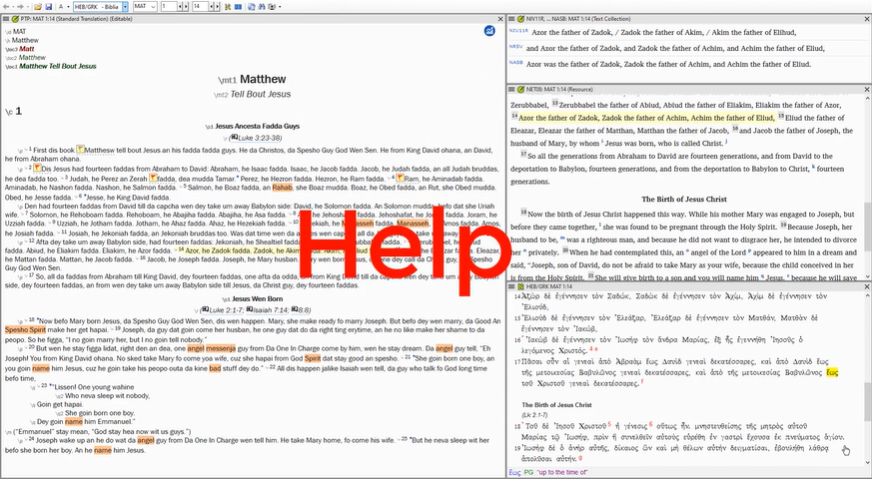
When I started my work with United Bible Societies I found all kinds of interesting situations. The way I understood my work was: my mission was to bring computers to translations projects that still were using typewriters, pens or even goose feathers, and/or to move all translation projects that were using all kinds of different computers to one system. The purpose was to make the text ready for typesetting from the very beginning.
It was not just a matter of translating to another language but using a system to organize the translated text in such a way that could go directly to book, chapter, verse, and paragraphs as the books of the Bible have traditionally been presented to the believers for centuries.
The divisions of individual books of Scripture into smaller sections started around the fourth century A.D. It was known as the Codex Vaticanus, a fourth century Greek manuscript that used paragraph divisions. These were comparable to manuscripts of the Hebrew Bible. Jerome, in the fifth century, divided Scripture into short portions, or passages, called pericopes. That word is still used now for a self-contained unit of Scripture. The work of Jerome was before the Scriptures were divided into chapters.
In 1277 A.D., Stephen Langton, who was an English cardinal of the Catholic Church and Archbishop of Canterbury, started the chapter division. He used the Latin Vulgate version of the Bible. In 1330, the Rabbi Salomon ben Ishmael took over the divisions from Stephen Langton’s Vulgate system, made some adjustments, sometimes accidently and sometimes with good reason, and he gave chapter divisions to the Hebrew text. The chapter divisions in the Hebrew text do not line up exactly with the English Bible. The Masoteric traditionalist Ben Asher family standardized the modern Old Testament division into verses around 900 A.D., but the practice of dividing the Old Testament books into verses goes back to centuries earlier. The current verse division for the New Testament is attributed to Robert I Estienne, also known as Robertus Stephanus, and sometimes referred to as Robert Stephens, a French printer. He divided the Greek text into verses for his Greek New Testament published in 1551, the Latin Vulgate. Many scholars have discussed the fact that Estienne proceeded to divide the verses and numbered them while on a trip from Paris to Lyon so the lack of logic in some of the verse divisions was attributed to horseback riding.
The first English Bible to have both chapter and verse divisions was the Geneva Bible (1560). Information mainly taken from (Lawton, Hong, and Hong 1997)
So, to represent all the book titles, chapters, verses, paragraphs, quotes, and other elements in the Bible, the organizations that participate in the translation of the Scriptures, use a code in front of every one of those elements of the Scripture. At the time I started my work, the code was known as Standard Format Markers.
I had to visit one of the branches of Wycliffe Bible Translator called JAARS to be trained in the utilization of those codes and to learn software that facilitated the analysis of the text once typed on a computer. Using the codes, we had software programs able to check “consistency” of translation across the whole translation. A software that did “word lists” so the translator could check spelling and location of each word in context. Another program allowed the translator to “compare” different texts. Another program, “Chapter and Verses” allowed the translator to check if all the chapter and verse numbers were correct for each book of the Bible.
Many other “utilities” allowed the translators to do “consistent changes” to their text when some spelling needed to be corrected, or punctuation needed to be changed.
My mission then was to bring all those programs to a Bible translation site, wherever it was, to teach the translator how to code the text and run those computer programs to check if the translation was ready to be sent to the typesetters.
I would usually bring all the programs needed, samples of text input with the codes already embedded, and a menu system that facilitated the use of word processors. Then I would install them in the computers the translators were using. In other cases, I would bring a new computer to the project with all the programs already installed and transfer the Scripture text they already had on diskettes to the hard drive of the new laptop or desktop computer. In many cases I started from nothing, teaching them how to use a computer. Sometimes I just brought a hard drive, containing all the needed programs, inside my purse and then replaced the hard drive, in a computer the project team already had, with the hard drive I brought. They either started a new translation or added the ASCII text files they already have in other computers, DVDs or thumb drives.
In most cases I would arrive at the translation project site and spend two or three days installing whatever programs were needed on their computers and then start the training.
In the 1980s, Gérard Genette coined a generic name: “paratexts” that refer to all features of a book beyond the main text itself (eg: page numbers, titles, chapter titles, subtitles, footnotes, endnotes, bibliographies, and indexes). “Paratexts” also includes legal texts about copyright, forewords, prefaces, tables of contents, title pages, cover art, version, date published and many other elements on a book.
(Gérard Genette, Lewin, and Macksey 2001)
After Microsoft replaced the DOS operating system with Windows, those programs still worked but several translation projects decided to move to Windows and use different word processors that complicated the matter.
So, around 1995, United Bible Societies started developing a Windows’ computer program that would allow translators to use it from the beginning of a translation and perform all those checks using only one software program. They named it “Paratext.”
I participated in many training events teaching translation teams how to switch to Paratext. In most cases it was quite easy to import into Paratext all the books of the Bible which were already translated and continue working with Paratext instead of a commercial word processor.
I was asked to work on developing the ‘Help’ system for “Paratext”, and I worked on that until my part was completed in 2004, when my position was declared obsolete. I had my mother to support. My pension from UBS was going to be very modest. Prayer and the advise of the Holy Spirit was my only weapon on what to do next.
Colossians 3:23-24 Whatever you do [whatever your task may be], work from the soul [that is, put in your very best effort], as [something done] for the Lord and not for men, knowing [with all certainty] that it is from the Lord [not from men] that you will receive the inheritance which is your [greatest] reward. It is the Lord Christ whom you [actually] serve. (“Bible Gateway Passage: Colossians 3:23-24 – Amplified Bible” 2015)
 An Ear by Mistake
You must be logged in to post a comment.