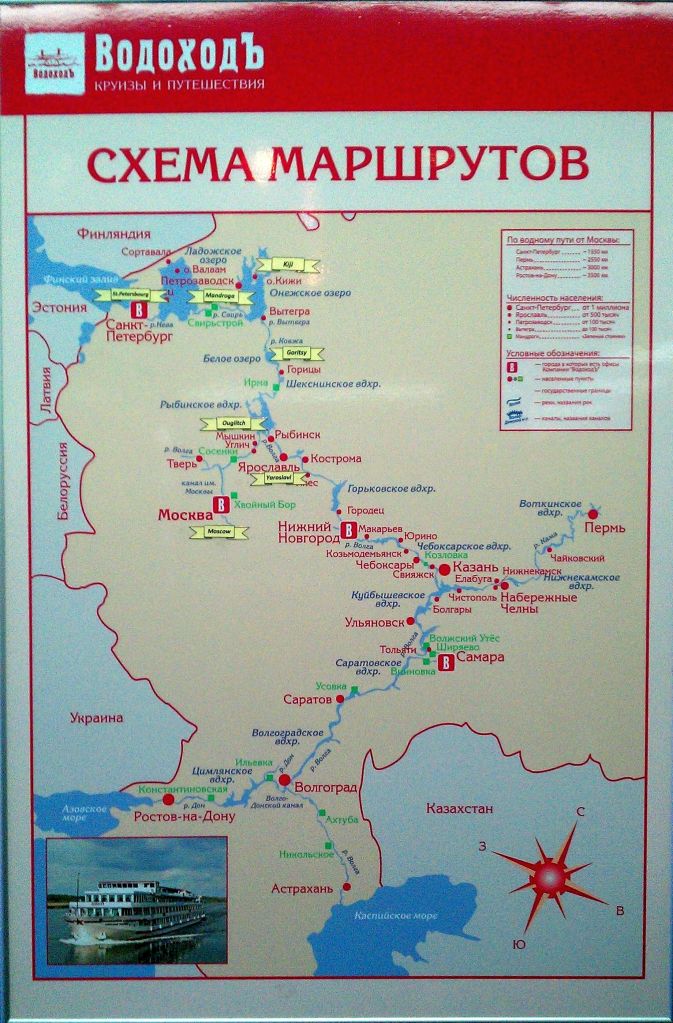
This was the name of the Power Point presentation and the video we made after our trip to Russia in September 2013. In December 2012, after some serious prayers, we decided to go to Russia. I found online a company based in Arlington, VA called “Travel All Russia,” and I contacted them by phone. I proposed a cruise on the Volga River, from Moscow to Astrakhan, in the Caspian Sea at the South of Russia, rather than doing the traditional cruise from Moscow to St. Petersburg. Fast, after I called, they sent us a proposed itinerary. In January 2013, we obtained confirmation for the whole trip. The company was going to take charge of all the planning, from air tickets to transfer from airport to ship, flight from Astrakhan to Moscow, a hotel before coming back to the US, and our visas.
We had to fill up and pay for an expensive application for a visa and send our passports to them to obtain the visas. The information required on the visa applications was incredible. The form included details about our parents, ex-husbands, our previous addresses, education since high school, employment from years back (including the name of our supervisors), trip insurance, countries we have been to before this trip, amazing! The Travel All Russia company also required similar amazingly detailed amount of information that we had to fill online. We filled eight pages in total. Finally, on August 5, 2013, we received confirmation, written in Russian and English, that our visas were approved for traveling in Russia from August 28 to September 15, 2013. That was only 23 days before the trip!
We were going to cruise on the MS Alexander Pushkin ship owned by the Russian company VODOHOD “Водоход”.
With all the documents needed for the trip we flew from Dallas to London on August 30. On August 31, we flew from London at 11:45 a.m. and arrived in Moscow 3 hours and 45 minutes later at Domodedovo International Airport. At the airport, a taxi driver was waiting for us. He had a big sign with my name. It took us two hours to travel from Domodedovo to the “Northern River Terminal” literally on the opposite side of Mocow. The city occupies an area of 970 square miles and has 16,000,000 inhabitants. The time is 9 hours of difference with Dallas.
We had learned that the Federation of Russia is divided into distinct types of federal subjects. It includes twenty-two republics, forty-six oblasts (provinces), and nine krais (territories). The republics of Russia differ from other federal subjects in that they operate under their own constitution and have a right to establish their own language. The oblasts have their own governments and legislatures. We were going to visit at least three republics and five Oblasts during our cruise.
We were received on board by a lady dressed in a beautiful costume and offering us a piece of a big loaf of bread with a hole in the top full of salt. This is a symbol of hospitality and respect. We had to break a piece of bread, dip it in the salt and eat it. It was delicious. Then we were shown to our cabin with two little beds, a desk, and a restroom. After the life jacket drill, we went for dinner, and we were so tired that we did not take the night tour in Moscow which we regretted later.
Next day we took a tour of Moscow. It was raining but then it stopped. On our way we saw the building of the KGB (Federal Security Service) at Lubyanka Square. We started at Red Square right in the middle of Moscow. The square separates the Kremlin, the former royal citadel and currently the official office of the President of Russia, from an historic merchant quarter. Lenin’s Mausoleum is also in Red Square. Adjacent to the square is St. Basil’s Cathedral. It was built from 1555–61 on orders from Ivan the Terrible and commemorates the capture of the cities Kazan and Astrakhan which we also saw on our cruise. This is one of the most stunning and beautiful cathedrals we have ever seen.
Moscow’s Kremlin is an imposing red brick fortress within the city. There we saw the Tsar Bell, the State Kremlin Palace that was built at the initiative of Nikita Khrushchev, the Senate Building, a late 18th-century Neoclassical structure that now houses the offices of Russian President Putin and the helipad constructed by Putin in 2013. Also, inside the Kremlin, we saw the Cathedral of the Dormition, the Cathedral of the Archangel, the Cathedral of the Annunciation, the Church of the Deposition of the Robe, and the Church of the Twelve Apostles. All these churches are inside Cathedral Square, (originated in 15th Century) which is the central square of the Kremlin.
On the eastern side of the square, lies the building which houses Russia’s most famous shopping mall, the State Department Store, GUM, which we visited. We were surprised to see all the world’s main fashion stores in this mall.
Then we went to Novodevichy Convent and gardens that have remained virtually intact since the 17th century.
We continued to the Trinity Church on Sparrow Hills also known as Vorobyovy Gory. There we not only did see hundreds of sparrows but also an Orthodox wedding ceremony all sung by the priests and a wonderful choir.
We returned to the ship for lunch and in the afternoon the tour took us to the Moscow State University, officially M. V. Lomonosov Moscow State University, which is a public research university in Moscow, Russia. That night on the ship we learned we were six groups of passengers from Australia, France, Sweden, Germany, three passengers from United States, and a couple from Puerto Rico, so all the announcements were in five languages. Our crew were students from different universities in Russia who were learning those languages and needing to have direct practice with native speakers.
On September 2nd, our cruise started navigating toward Uglich. In fact, we were on the Moscow Canal that is eighty miles long and connects to the River Volga in the town of Dubna, which is located just upstream of the Ivankovo Reservoir. We went through five locks with elaborate architecture and many statues and under man bridges. The Volga River is the longest river in Europe. It is Russia’s main commercial waterway. It provides connections between the Baltic Sea, St. Petersburg, Moscow, the Caspian Sea, and the Black Sea. That night our crew gave us a good show with songs and dances.
Next day, September 3rd, we arrived at Uglich. All passengers came to the top of the ship to see the famous ‘Church of St. Dmitry on the Blood’ is part of the Uglich Kremlin. The church was built on the site where the 10-year-old prince Dmitry son of Ivan the Terrible, of the ancient Ruyrik dynasty, was murdered by Boris Godunov before Godunov claimed the throne of Russia and was murdered himself. This happened in 1591. After we got off the ship we were welcomed again with bread and salt by a lady, dressed in the ethnic dress of that area, and a small band. We went through a street market and visited the town where we took pictures with the old lady that sell flowers (made famous by Viking commercials on TV). In Uglich we attended a beautiful a Cappella concert. We also saw the interior of the St. Dmitry on the Blood Church with incredible icons.
Our stops next day were both Yaroslavl and Kostroma, two different cities. In Yaroslav, built in 1003, we first visited the Cathedral of the Assumption where the main attractions are the 17th century frescoes. The frescoes depict the life of saints. Overall, about 200,000 people from the Yaroslavl area died on the fronts during World War II. This sacrifice is memorialized through a monument and eternal flame near the mouth of the Kotorosl River in 1968. We saw the Alexander Nevsky Chapel, the market, and the Church of Elijah, the Prophet. After being hosted at the Governor’s House, turned museum, with a concert and dance (with champagne), we returned to the ship to go to Kostroma the same day.
We arrived in Kostroma in the afternoon. The city is much smaller than Yaroslav. We first saw the monument to Ivan Susanin and then went to the market. We went to the Fire Lookout Tower, the house of General S. Borshchov, the Ipatiev Monastery and many charming wooden houses throughout the city. We also saw the market where the sweets looked good.
Next stop was Nizhny Novgorod. It is the fourth largest city in Russia with a population of 1.3 million. It is located at the confluence of the Volga and Oka Rivers. We visited their very impressive Kremlin, built in 1508. Our bus went through Bolshaya Pokrovskaya Street, and we saw the Pechersky Ascension Monastery. During much of the Soviet era, this city was closed to foreigners to safeguard the security of Soviet military research and production facilities.
We arrived at Cheboksary, the capital of the Chuvash Republic in Russia. This is a Turkic ethnic group in that area. We visited the Pechersky Ascension Monastery where we had to wear a wrap arounde our slacks so we could go inside the church. We saw the Mother Patrones Monument and we visited their Kremlin. That night at the ship we had a big party where all the crew presented different songs and dances and played instruments.
Next was Kazan the former capital of the Tatars in the republic of Tatarstan. We visited the St. Peter and Paul Cathedral, the May 1st Square, inside the Kazan Kremlin, we saw the Kul Sharif Mosque, the Cannon Yard Complex, the Söyembikä Tower, and the Annunciation Cathedral. We saw the Temple of All Religions and the Dvorets Zemledel’tsev building which is the Palace of Agriculture.
Back on the ship we painted Matryoshka dolls and had a typical Russian dinner.
Our next stop was Samara which is an Oblast. We toured the city and saw the Sacred Heart Church (that had the Christ of Saint John of the Cross painting by Salvador Dalí), the Smara Academic Drama Theater, the Monument to Vasily Chapaev, the historic Stalin’s bunker under the Samara Sate Institute of Culture. The bunker was built over nine months by a team of eight hundred engineers and 2,900 workers but was never used. It was declassified in 1990 and then turned into a museum. The last we saw was the Soyuz carrier rocket monument.
Before we arrived in Saratov, we encountered a big thick fog at the Saratov Reservoir, which is another of the artificial lakes in the lower Volga. We had to wait for 4 hours before the fog lifted enough to proceed. Then we went through the lock and made our way down river to Saratov. Until the end of the Soviet Union in 1991, Saratov was designated a “closed city”, strictly off limits to all foreigners due to its military importance. It is the main military aircraft manufacturing facility in the country. We had to anchor in the river & take a smaller boat (like a tender) to reach Saratov. Because of the delay due to morning fog, it was dusk before we reached Saratov. We saw a gorgeous Christian Orthodox Church in downtown, and the most prominent landmark built in 1912, the neo-Gothic Music Conservatory. In front of the conservatory is this statue of Nikolai Chernyshevsky, a revolutionary philosopher. Surrounding the town plaza is a marvelous diorama depicting the history of the city since 1590. We learned that a large German community had immigrated in the 18th and 19th centuries. After the German invasion of the Soviet Union during World War II, the government expelled more than half of all Volga Germans to Uzbekistan, Siberia, and Kazakhstan and some to Western Europe.
Our ship, heading down the Volga, navigated a huge bend in the river as we approached Volgograd, and a giant statue, “The Motherland Calls,” came into view. We could tell the statue was huge; later we would find out just how huge.
Volgograd, formerly Stalingrad, has one of the most amazing war memorials we had ever seen. It is actually ten separate memorials in sequence. The memorial complex covers about 2.8 million sq ft and stretches from the top of the hill to the foot for almost one mile. Many of our fellow passengers grew silent as they stared at the massive figure of Mother Russia, seventeen stories or 257 feet high (100 ft higher than the Statue of Liberty). Some Russian passengers quietly wiped away a tear as they viewed the “Rodina mat soviot” (The Motherland Calls).
During World War II, Stalingrad became the center of the Battle of Stalingrad. The battle lasted from August 21, 1942, to February 2, 1943. More than one and a half million Soviet soldiers were either killed, wounded or captured, as well as over 50,000 civilians killed. The city was demolished to rubble during the fierce fighting, but reconstruction began soon after the Germans were expelled from the city.
We were taken to the Panorama Museum, a circular building with a panorama painting that vividly illustrates the fierce combat that took place in Stalingrad. There we had the privilege to see the end of a very special ceremony held that day, September 10, 2013. It was a significant event commemorating the 70th anniversary of the end of the Battle of Stalingrad. Local government officials, military representatives, veterans, and citizens have laid wreaths at the memorial, and they were leaving the place when we arrived. We also saw the soldiers marching out of the building. I was a very impressive experience.
The names of soldiers cover the walls of the circular building. Six hundred are buried in the memorial. A Mother and Son sculpture shows a banner draped over the face of the son so he can represent any of the fallen.
The next level of the complex has a long reflecting pool, lined on one side by six imposing sculptures of battle scenes. Sculpted walls, resembling bombed out buildings, display faces of soldiers and battle scenes as well as graffiti left by soldiers in the trenches. “We have no food. We have no boots. We sleep as we walk. Every house is a fort.” Looking back, we see the pool and Mother Russia. At the next level down, there is a circular pool with another sculpture at the center, representing every Russian soldier who defends Motherland Russia. Following a walkway lined by poplar trees and more steps comes this final sculpture. There are two hundred steps total from the bottom of the hill to the top, each representing a day in the battle. And the alley of poplars is also 200 m long. After the battle, the whole city looked like this bombed out mill; it was left to show the destruction left by the Nazis. It is impossible to visit this memorial and not be moved by it.
After a day of sailing, we arrived at Astrakhan. It is formed by eleven islands linked together by bridges. It is 22 m below sea level and 4 to 7 m above the level of the Caspian Sea. The Astrakhan’s Kremlin was built from the 1580s to the 1620s. The Kremlin was built from bricks pillaged just next to river Volga. Inside the Kremlin we saw the Assumption Cathedral, the Trinity Cathedral and the churches of the Presentation of the Lord and the Introduction in Virgin Mary. Astrakhan has been known as Russia’s caviar capital, but no more. In the ninety’s the sturgeon was near extinction, so Russia has banned all commercial sturgeon fishing in the Caspian basin and the export of all black caviar. Prices when we were there were high. We suspect this might have been a black market. Of course, the city is full of cats like many of the other cities we saw during our cruise.
Before we left the trip I gave a New Testament in Russian to the girl who was in charge of selling souvenirs and making the announcements on the ship. She was very sweet. After talking to her several times, I asked her if she knew Jesus. She said that she had heard of him. So I asked if she was interested in learning more and, when she said ‘yes’, I knew it was for her that I had brought the New Testament.
On September 13, 2013, we flew on Aeroflot from Astrakhan to Moscow. The plane was new and had great leg room. We arrived at the Sheremetyevo (Tsorimiétziwa) International Airport in the Northwest of Moscow, but we were to leave out of the other airport (Domodedovo) on the other side of the city the next morning. Wisely, our agent in the US had booked us into the Airhotel near Domodedovo to spend the night. It took our taxi 2½ hrs. from one airport to the other, even when doing a loop to avoid the massive traffic jams on the main highway.
This time the taxi driver was a mature man that did not speak English but he had a laptop with a translation software. Even when I took two years of Russian lessons when I was very young I was not able to carry a conversation in his language so, I opened the app that I installed in my phone before the trip. I was able to use it offline. We had a conversation using our gadgets. I learned about his children and grandchildren. He has been driving a taxi since he was very young. Had difficult times during the political changes. He had already been a taxi driver during the years of the Soviet Union starting in 1963 when Taxi services were state-owned, and drivers were employees of the government having a very low pay. He drove a Moskvitch, a Rusian made car, which was old and unreliable. Most people could not afford to call a taxi so they used public transportation. He had hard times providing for his family. In the late 1980s he saw the emergence of unofficial taxi services, or “gypsy taxis,” which were not regulated by the state. He only could afford to rent a car to become more independent in the late 80’s after Mikhail Gorbachev introduced reforms with the perestroika, which means restructuring. Then he bought a laptop which he managed to install on a special metal support on his dashboard so he could type with his right hand. He had GPS navigation and the translation program that improved enormously his business.
Our flight home was from Moscow to Heathrow in London, then to Dulles in Washington, D.C., and then to DFW in Dallas. We arrived on September 14, 2013, at 6:10 p.m. when in Moscow it was already 2:10 a.m. on September 15, 2013.
 An Ear by Mistake
You must be logged in to post a comment.