Working at the Americas Branch of United Bible Societies was interesting. All people at that office except one, from Canada, were from different “Spanish” speaking countries. We were people from Mexico, Puerto Rico, Nicaragua, Colombia, Peru, Bolivia, Chile, and Cuba.
When occasionally we were together at the lunchroom our dialogue was always interrupted with, “What did you say?” Many times, we had said something that had a bad meaning or just was not used in the same context in another country. The fact is that a very same word in “Spanish” may have different meanings in different countries and even different meanings in different regions of the same country.
It is the same phenomenon that happens in English spoken in England, Australia, and the United States. Or American English spoken in Texas compared to Rhode Island, for instance.
When I started working there, in 1985, the General Director of the Americas Region was Don Alberto Carcamo. He was also from Chile. Then he was succeeded by Don Jaime Goytia, from Bolivia.
Doctor Luciano Jaramillo and his family, from Colombia, invited me and my parents to spend Christmas with them over the years. We felt totally at home with their Spanish and habits. It was easy to continue the friendship for years. I still communicate with Athala, Luciano’s widow. I have excellent memories of many of my co-workers in that office.
I worked with two girls from Chile in my office of Computer Assisted Text Processing. Aline Camus and Emma Canales promptly learned the software necessary to check the text of different translation projects. We traveled together to train many different Bible translation teams in how to use computers and the software. In total, I counted more than 58 Bible Translation projects that I either trained or worked with directly or indirectly.
The city of Miami itself has gone through substantial changes due to the “invasion” first of Europeans and then from diverse cultures from Central and South America.
The Tequesta Indians were the first inhabitants of South Florida for over a thousand years. European contact began in the 16th century with Spanish explorers, notably Juan Ponce de León in 1513. Spain first claimed Florida that year. Then it changed hands to British control from 1763 to 1783. Then it returned to Spain and then became a U.S. territory in 1822. It became a state of USA in 1845.
The Seminole people began to form in the 18th century, primarily from Creek Indians and other groups migrating to Florida from the north. They spoke the Muskogean language. They had man attraction locations on the road from Miami to Tampa.
The Miccosukee Tribe of Indians were originally part of the Creek Nation. They migrated to Florida before it became part of the United States and resisted removal during the Indian Wars of the 1800s.
My parent and I enjoyed the Miccosukee Indian Village in that area. We always took visitors there. Also, the Miccosukee tribe operated a Casino near Miami. My parents enjoyed going to the restaurant of that Casino because the steak and lobster meal was very conveniently priced there.
We learned that the Miccosukee Casino & Resort had a bus going every day to the Cuban area in Miami, collecting senior Cubans who normally left their monthly pensions or Social Security at the casino. But the Seminoles treated them well, they said.
Cuban immigration to Miami began after the Cuban Revolution in 1959, with many Cubans fleeing to the area due to political and economic reasons. In fifteen years after the Cuban Revolution, more than half a million Cubans moved to Miami.
Haitian immigration increased during the 1980s, particularly during periods of political unrest in Haiti.
There were several different neighborhoods in Miami at the time I lived there. Little Havana is the hub of Cuban culture, known for old gentleman paying dominoes, seated at small tables next to a café on the street, cigar shops, and authentic Cuban cuisine. We particularly enjoyed going to Café Versailles.
Little Haiti was the center for Haitian culture. It had art galleries, restaurants, and presented several cultural events that celebrated Haitian heritage. I still remember when the Haitians started migrating to Miami, and they practically took over the business of taxis at the airport. It was a big problem with the Cuban taxi drivers.
South Beach is known for its nightlife and Art Deco architecture. This part of Miami is the part that attracts more tourists and is known for its history with the mafia in the past.
Another area was Liberty City, a significant center for the African American community in Miami. We did quite a bit of evangelization in that area of Miami.
It was in Miami that I attended my Cursillo of Cristianidad and then started to serve in Kairos Prison Ministry.
During my time in Miami, I was a member of the South Florida Center for Theological Studies Board of Trustees. The president and founder of the center was Dr. Melvin E. Schoonover. The center was founded in 1983. Dr Schoonover had served as a Senior Minister at the Chambers Baptist Church in East Harlem and was also the former Dean of Continuing Education at New York Theological Seminary.
I also taught a Communications course at the seminary. The center was created to address the educational needs of those pursuing theological studies in South Florida.
Hurricane Andrew
The best part of being in Miami was the visit to the beach in Miami Beach in front of all the beautiful hotels, remanent of the Art Deco era in Miami. Many times, when an intense storm was announced on one of the TV channels, my mother and I would take the car and go to the beach with raincoats and big umbrellas to sit in front of the ocean and enjoy the storm. The color of the usually green sea turned to deep blues and greys, and beautiful large waves bathed the beaches. We did not know how dangerous a massive storm could be until 1992.
It was August 1992, and I was attending a conference in North Carolina. I heard on the radio that a hurricane was coming in the direction of Miami, and I hurried to drive to Miami to be with my parents during the predicted hurricane. As soon as I arrived at the apartment I went with my father to buy big sheets of plywood and big cement bolts, at Home Depot. We fixed the plywood to the surrounding walls with bolts to protect the big glass doors of our balcony that overlooked the golf Club.
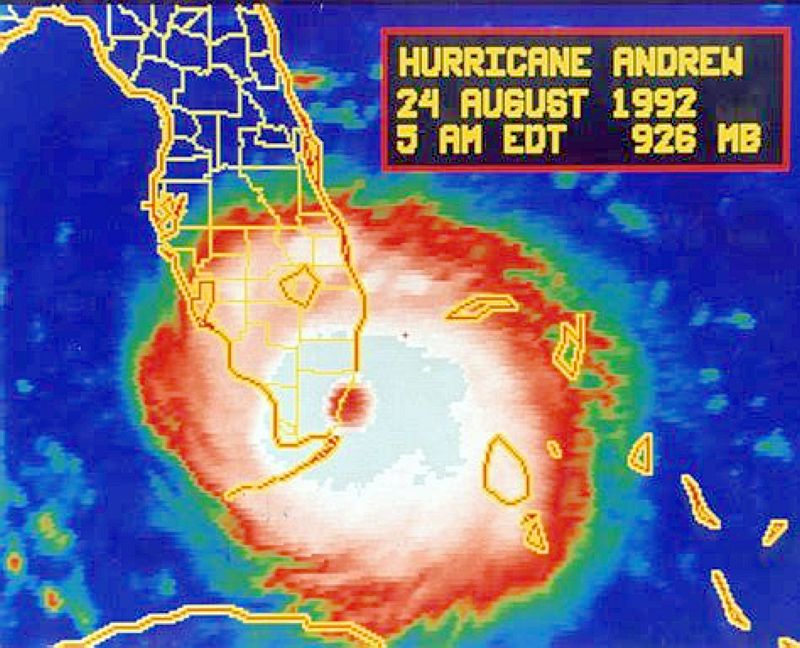
Hurricane Andrew formed in the Atlantic Ocean on August 16, 1992. It intensified as it moved westward, falling in Florida on August 24, 1992.
Andrew made landfall in the early morning hours of August 24, with winds exceeding 165 mph. The eye of the hurricane passed directly over the southern part of Miami-Dade County, where we lived, causing catastrophic damage.
During the first part of the landfall, we saw the two pieces of plywood come out of the walls and flap against the railing of the balcony as if they were playing cards. Through the window of my parent’s bedroom, which faced the golf club, we saw trees being uprooted in front of our condominium. Our building flooded on the fifth and the second floor. The heavy rainfall penetrated the window of my room on the second floor, and we had at least six inches of water over the wall-to-wall carpet. Two of my bookcases made of cheap plywood were so wet that they started disintegrating. We had to empty all the books and put them on top of the kitchen counters. We had a bit of calm while the eye passed over us and then it struck again.
The rainfall led to flooding. We had between 8 to 12 inches of rain in some areas.
In the morning after the horrific experience God brought us an amazing gift. When father and I went to lift what it was left of the plywood sheets in our balcony we saw the most incredible view. The golf area in front of us was totally white. It was covered with little egrets that were enjoying the meal the hurricane had left behind for them. It was calm after the storm and the birds were a beautiful sign.
The Las Brisas Village Association got together to assess the damage, and there was much. Our air conditioner condenser on the roof of the five-floor building was damaged as well as many others. We praised the Lord when we were able to locate an air condition specialist in the area that had some used condensers that could replace our unit until we were able to buy a permanent one. Much of our furniture was ruined. We were grateful when a State Farm appraiser came. He took note of all the damage we had had. I cannot complain on how well that insurance company treated us.
We were able to give away some of our furniture and after some small repairs were able to help other people who were left with nothing. I had a nurse friend of mine who lived in a building that was totally damaged, and she lost all her furniture. We donated a new bed for her.
One of my friends, her husband and two children had just bought a house in a new development called Country Walk. Hurricane Andrew severely destroyed this area. Ninety per cent of the 1,700 homes in Country Walk were destroyed. Their lives were saved just because the Lord guided them to take shelter in the half bathroom downstair. When they open the door of the bathroom next day, the house was gone.
Following the hurricane, property owners filed lawsuits against the developer of Country Walk, Disney through Arvida, for shoddy construction. In the subsequent years, the homes were slowly rebuilt. Unlike the destroyed homes which were made of wood frame construction, the new homes were rebuilt with concrete walls.
Hurricane Andrew destroyed over 63,500 homes in Florida and left more than 160,000 residents homeless. The storm resulted in 65 fatalities and approximately $27 billion in damages. It was one of the most devastating hurricanes in U.S. history.
My parents and I thought that earthquakes were terrible, but we came to the conclusion that hurricanes are worse because their destruction lasts hours instead of minutes.
 An Ear by Mistake
You must be logged in to post a comment.