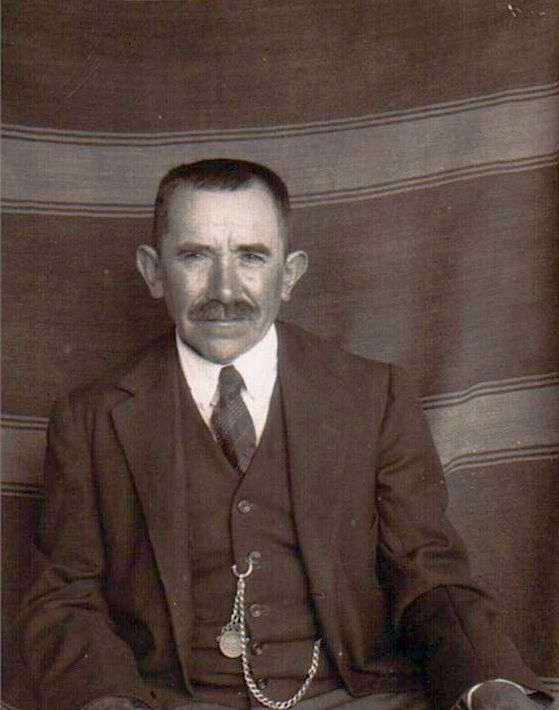
Juan Manuel Beltrán Beltrán was the son of two cousins. My great grandparents had played together during their whole childhood. They got along very well. The families decided that the best thing was to marry them because they liked each other so much. They were fourteen years old. They both had the same last name because their fathers were brothers. This was not uncommon in Chile at that time.
However, they lived in the house of the girl’s parents where they gave them a room. The story was that they continued playing and having fun as innocent children until they were around 20 years old when they finally understood what marriage was about and they had a child. At least that is what we were told.
I am not sure if my grandfather was the first born or not; however, I know he was sent to school and then kicked out because he fell in love with the schoolteacher. His father thought that he would be better off helping him at his ranch.
My father and mother were a little vague about how many other children the parents of my grandfather had. I do not remember them mentioning the name of the mother of my grandfather, either. They always talked about the “abuelito Pedro” (my father was named after him), but I do not even know what side of my family he was from.
I do not have any recollection about learning how my grandfather met my grandmother, Hortencia Neira. All I know is that, jokingly, my Beltran family said that she was a descendant of the famous bandits in Chile the “Neira brothers”, who were a group of outlaw patriots who played significant roles in the early movements for independence from Spanish rule. Much later I learned that her cooking habits were totally “kosher” so she must have had some Jewish blood in her family.
In time, a cousin of my grandfather, Teobaldo Beltran, asked him to take charge of his ranch and farm near Los Angeles in Bio Bio region. So, my grandfather and his family moved to Los Robles Ranch close to where he grew up in the Bio Bio region in Chile. My grandmother seems to have been from Concepción because she had a sister that lived there, my great Aunt Celmira.
My father was never sure when exactly he was born or where because he said my grandfather only registered him after he was some years old. The story was that my grandmother had lost her first child and then her first daughter before they had reached their first year. This was not uncommon at all in the south of Chile because of the freezing weather and respiratory infections in babies. My grandmother had fourteen children but only seven survived. So, when my father was born, she asked a Mapuche woman to feed my father to make sure he survived.
According to the family stories, my father was born in Constitución, but my grandfather registered him as born in Concepción on December 3, 1903. Father said that he was born at midnight, so he celebrated on December 4th.
My grandfather loved to talk about the adventures of his uncles who were train operators. In fact, the construction of the railway between Concepción and its nearest port of Talcahuano and the city of Chillán was a challenge at the time it was built. They were 116 miles of track on a route along the banks of the Biobio River. The route had more than a dozen bridges. My grandfather remembered that the construction was under the direction of an American engineer, Juan Slater. He thought the inauguration was at the beginning of 1870’s.
Somewhere after the San Rosendo station, near Laja city, was the connection to the Araucanía, a region in southern Chile, known for the presence of the indigenous Mapuche people. The same engineer, Slater, built a missing link between Curicó and Chillán, completing then a railway connection from Valparaíso, the main port in the middle area of Chile, and Talcahuano, the port next to Concepcion in the south. The construction of the branches from San Rosendo to Angol and Los Ángeles, followed. (“El Ferrocarril En Bío-Bío Y Ñuble – Archivo Histórico de Concepción” 2014)
My grandfather said all the laborers were Mapuches, the original indigenous of the area. Grandfather told us that his uncles would go to parties by driving the train, and they had girlfriends at every station in that region.
My grandfather had an amazing sense of humor. When we would go with him to a restaurant, for instance, he would start joking with the waitress and very soon he would involve all the clients of the restaurant in jokes and toasts. He would pursue a waitresses and kneel to ask her for her hand, or he would make different animals with the napkin and show it to the children on the next table or just pour some wine and stand up in his chair and make everybody in other tables to stand up and have a toast with him.
One of his favorite stories was about a well known doctor in Chile. According to my grandfather, Dr. Alessandri, who was the son of the president Arturo Alessandri in Chile, operated on a lady so many times for hernias that he finally decided to use calf tissue as a biological patch to reinforce the abdominal wall during her hernia repair. Of course, he aimed to reduce the risk of recurrence. My grandfather said that at the end of the procedure, Dr. Alessandri told the lady not to visit farms that had bulls around, just in case.
He would recite poems that he had learned from his Mapuche friend, El Maucho, who was good at playing the guitar and participated in “payas“. These were traditional contests in Chile that took place during social gatherings, including fiestas, rodeos, and community celebrations. These “payadores“, or folk poets and musicians, came together to display their talents. The “payadores” were skilled in improvisation, creating verses on the spot that reflected current events, social issues, or individual experiences. They are guitar and singing duels. Grandfather always introduced some all sayings in French. He vaguely remembered his grandfather, Jean Baptiste, who carefully taught him some mean sayings and jokes in that language. He must also have been a teaser like my grandfather.
This ability my grandfather had was very engaging. Everybody loved him. Unfortunately, he came down with some stomach sickness and died when I was still in High School.
I have told some of his most famous stories in other “cuentos” or short stories.
 An Ear by Mistake
You must be logged in to post a comment.