Well, in 2013 we had already done the Panama Canal, halfway only, from the Caribbean side. We had not done it from one ocean to the other. We had to do it the whole way! Besides, there were several countries in Central America we had not seen yet. At that time, I had only been in seventy-three countries. Now they are 86 and counting!
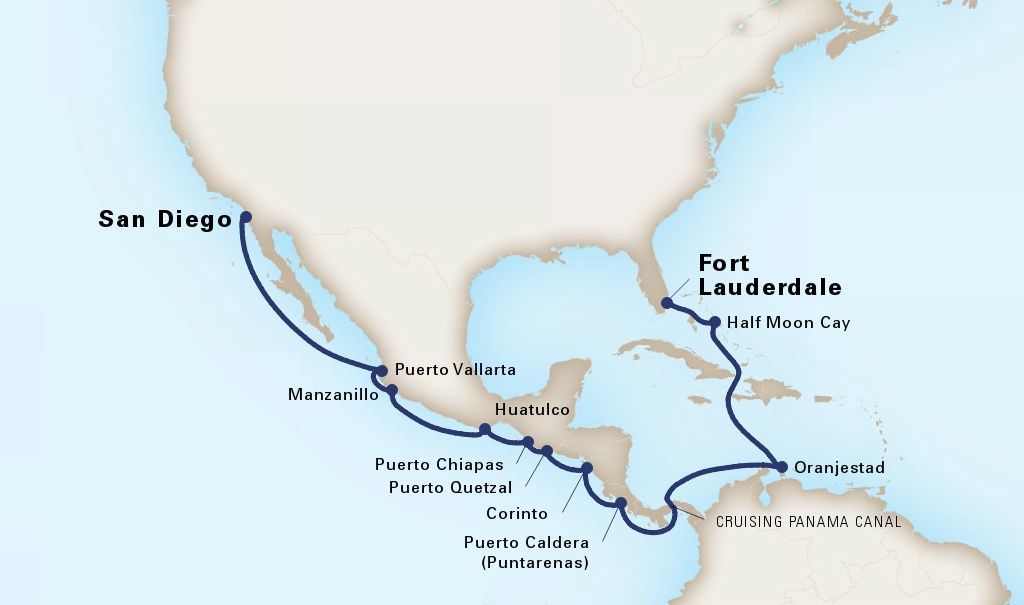
Thus, in July 2019, we placed a deposit for a cruise from San Diego to Ft. Lauderdale with Holland America. The ship would be MS Oosterdam and the time, January 18 to February 5, 2020. Right after that I was supposed to go to Chile for a family matter. The timing worked perfectly. God has always arranged timing to allow us to combine trips (or allow us to be at the right place at the right time!). On top of this I would be in Chile for my birthday!
We flew American Airlines to San Diego on January 18 and embarked the same day. The next two days we were at sea.
Our first port was on January 21, Puerto Vallarta, Mexico. Since we had been there before we did not have any excursion in mind. To our surprise, representatives of the resort known as Vidanta Nuevo Vallarta were at the port offering a free tour of the famous place. We accepted. The place is only 30 minutes from the center of Puerto Vallarta. We were taken to the Mayan Palace a luxurious Hotel on the resort. The entrance is magnificent with Mayan motives. We saw some rooms at the hotel. We were invited for lunch and to relax while we were there. Then we went back to the ship.
Next port was Manzanillo, Mexico. This is a port with two beautiful beaches Bahia de Manzanillo and Bahia de Santiago. We took an excursion to see both. The guide emphasized that there are plenty of all-inclusive Hotels there that are famous and not so expensive. We saw several monuments to local heroes.
After a sea day we arrived at Huatulco, Mexico. We were received by a group of dancers. Then we took an excursion up the hills that allowed us to have a panoramic view of the port. This port has nine bays and over thirty beautiful beaches. We visited Santa Cruz, a quaint beach town with a marina and La Crucecita, or Little Cross, known for its local markets and authentic restaurants. We also saw some of the Huatulco National Park.
The next port was Puerto Chiapas, Mexico. After we went down to the port we were taken to the cruise terminal. It features two main buildings: a larger one with a market for local crafts and an event space, and a smaller building housing a restaurant and bar with Wi-Fi access. We enjoyed watching several folkloric dance groups and a band of musicians playing two huge marimbas typical of that area in Mexico.
Our next port was Puerto Quetzal in Guatemala. Here we took an excursion to Antigua located 2 hours from our port. This is an historic city known for its well-preserved colonial architecture. We visited the Catedral de Santiago, the Santa Catalina Arch, and the ruins of various churches. The entire place reflects the city’s past as the capital of Guatemala from 1543 to 1773. Unfortunately, it was destroyed by earthquakes. We enjoyed spending time at the main Square watching the locals and native vendors. It was worthwhile to see the place that I heard so much about from my friends in Guatemala.
Next day we arrived at Puerto Corinto, Nicaragua. This is a sheltered harbor making it an exceptionally good port. It was founded in 1849. We visited two churches there the Iglesia Santo Tomás Apóstol and the Church of San Pedro. We also went to the Mercado Municipal de Corinto which offered us a glimpse into the local life and a museum.
We were interested in learning that in 1895 British forces occupied Corinto. This occupation was the result of the British imperial interests in Central America. The British tried to protect their commercial interests considering the construction of the Nicaragua Canal, which was seen as a potential rival to the Panama Canal. Nicaraguan nationalists resisted the occupation.
We also learned the United States has had a significant presence in Corinto. US military forces intervened during political unrest in the late 19th and early 20th centuries.
Our next stop was Caldera in Costa Rica. It is equipped with modern port facilities. We took an excursion to the Andalusian Horse Show at Rancho San Miguel, a renowned school of high equestrian arts in the Alajuela Province. The show was impressive. These were purebred Andalusian horses that perform, guided by talented riders. They also presented Spanish Flamenco music.
After two more days at sea, we arrived at the Pacific entrance of the Panama Canal located on the southern end of the canal, near the city of Balboa, which is part of Panama City. The journey began at the Miraflores Locks located near Balboa. Our ship was raised fifty-four feet to the level of Gatun Lake. There are two chambers in the lock, allowing for simultaneous passage of ships in both directions. The locks filled with water from Gatun Lake, lifting the ship.
After leaving the Miraflores Locks, our ship navigated for about three miles to Pedro Miguel Locks. Here, the ship was raised an additional thirty-one feet to reach the level of Gatun Lake. This lock has one chamber, which operates similarly to the Miraflores Locks.
Once through the Pedro Miguel Locks, our ship entered Gatun Lake, a large artificial lake that is a significant part of the canal and it is twenty-three miles long. At Gatun Lake, our ship navigated through various channels and by islands within the lake, following marked routes. After crossing the Gatun Lake, the ship entered the Gatun Locks on the Atlantic side. These locks have three successive chambers, which lower ships eighty-five feet to sea level. The locks filled and then emptied using water from the lake and allowed our ship to descend to Limon Bay in the Atlantic Ocean.
The whole crossing of the Canal took at least 9 hours.
We spent another day at sea, and we arrived at Oranjestad, Aruba Island, in the Caribbean Sea. Here, after a small tour of the port admiring the colorful Dutch colonial architecture and Fort Zoutman, we took a great sailing tour that lasted about three hours.
Two more days at sea and we arrived at Half Moon Cay or Little San Salvador Island in Bahamas. This is a private island in the Bahamas, owned by Carnival Corporation. We enjoyed the hospitality of our wonderful crew.
Next morning, February 5, 2020, we arrived at Port Everglades, Fort Lauderdale. We did not have to rush to the Miami airport to take our flight to Chile because it wasn’t until 10:50 p.m.
Now we have gone from the Atlantic to the Pacific around the southernmost point, Cape Horn, and from the Pacific to the Atlantic between the America continents, Panama Canal.
 An Ear by Mistake
You must be logged in to post a comment.